Master the 52-Week Frugal Challenge: Save Over $1,300 in One Year
Embark on the 52-Week Frugal Challenge and transform your savings habits. This guide provides actionable steps to save over $1,300, boost your financial literacy, and achieve your money goals.
By: Matheus Neiva on June 10, 2026
Last updated on: July 31, 2026
Master the 52-Week Frugal Challenge: Save Over $1,300 in One Year
Master the 52-Week Frugal Challenge: Save Over $1,300 in One Year
Are you looking for a simple yet effective way to boost your savings? The 52-Week Frugal Challenge is a phenomenal strategy designed to help you accumulate a significant sum of money over the course of a year, specifically targeting over $1,300 in savings in the US. This challenge is not just about stashing away cash; it’s about building consistent financial habits, increasing your awareness of your spending, and ultimately, achieving your financial goals. Whether you’re saving for a down payment, a vacation, an emergency fund, or simply want to improve your financial discipline, the 52-Week Frugal Challenge offers a structured and rewarding path.
The beauty of the 52-Week Frugal Challenge lies in its simplicity and adaptability. It starts small, making it easy to commit, and gradually increases the savings amount, allowing you to adjust your budget as you progress. This approach prevents burnout and makes the journey enjoyable rather than daunting. In this comprehensive guide, we will delve into every aspect of the challenge, providing you with the tools, tips, and motivation you need to succeed. Get ready to transform your financial landscape and watch your savings grow!
What is the 52-Week Frugal Challenge?
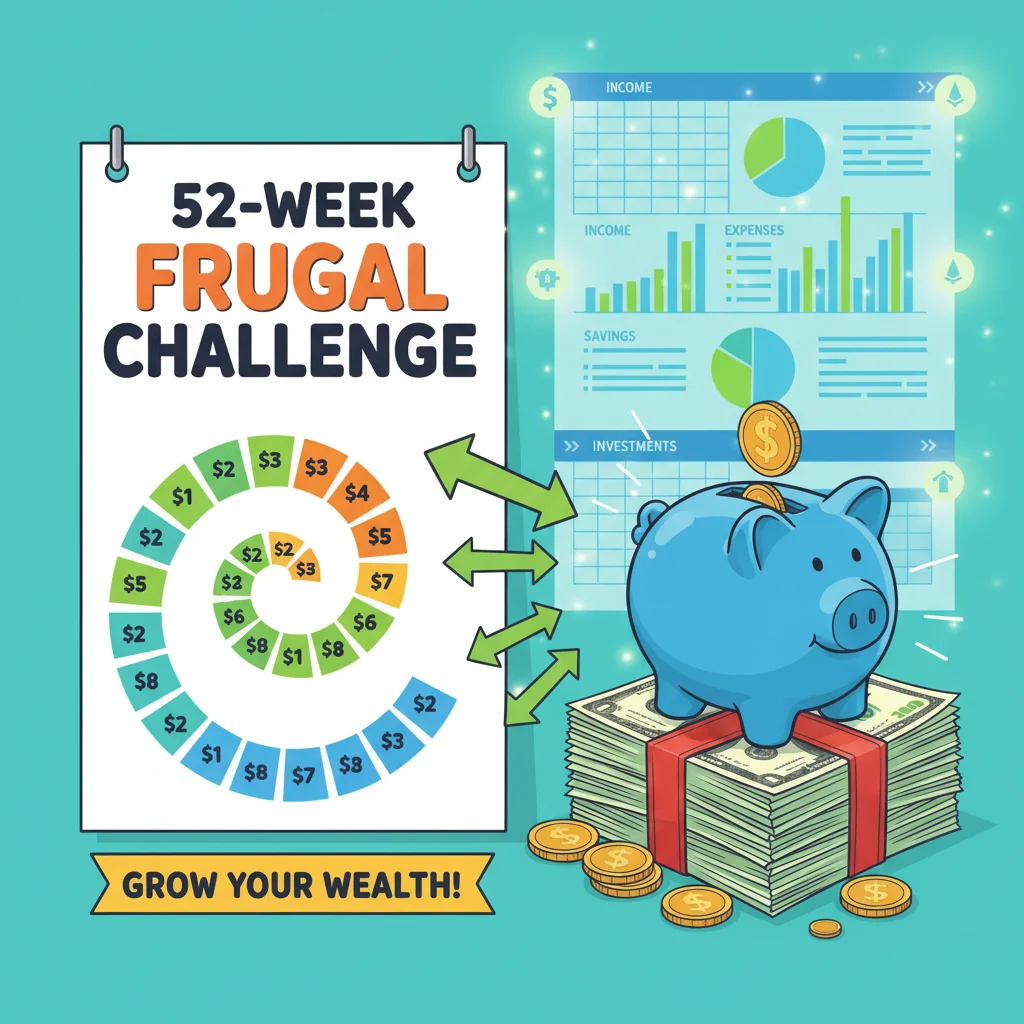
The 52-Week Frugal Challenge is a popular savings method where you save a progressively increasing amount of money each week for 52 weeks (one year). The most common version involves saving $1 in week one, $2 in week two, $3 in week three, and so on, until you save $52 in week 52. By the end of the year, following this traditional model, you will have saved a grand total of $1,378. This systematic accumulation makes saving feel less like a chore and more like a game, with tangible progress each week.
The challenge is particularly effective because it leverages the power of gradual habit formation. Starting with a small amount makes it accessible to almost anyone, regardless of their current financial situation. As you successfully complete each week, you build momentum and confidence, which makes saving larger amounts in later weeks more manageable. It’s a brilliant way to introduce financial discipline without overwhelming yourself.
However, the 52-Week Frugal Challenge isn’t a one-size-fits-all solution. There are several variations you can adopt to better suit your income, spending habits, and financial goals. For instance, some people prefer to reverse the challenge, starting with $52 in week one and decreasing the amount each week. This can be beneficial if you anticipate having more disposable income at the beginning of the year or prefer to get the larger sums out of the way first. Others might choose to customize the amounts, perhaps saving a consistent amount each week or adjusting based on their fluctuating income. The key is to find a system that works for you and keeps you motivated.
Understanding the core concept of the 52-Week Frugal Challenge is the first step towards financial success. It’s more than just saving money; it’s about developing a mindset of intentionality with your finances, identifying areas where you can cut back, and celebrating your progress along the way. This challenge serves as an excellent foundation for building long-term financial stability.
Why Embark on the 52-Week Frugal Challenge?
Committing to the 52-Week Frugal Challenge offers a multitude of benefits beyond just the final savings total. It’s a journey of financial enlightenment and empowerment. Here are some compelling reasons why you should consider taking on this challenge:
Builds Financial Discipline: Consistency is key in personal finance. The weekly commitment of the 52-Week Frugal Challenge instills a routine of saving, turning it into a habit rather than an occasional act. This discipline can spill over into other areas of your financial life, leading to better overall money management.
Creates an Emergency Fund: For many, the primary motivation for taking on the 52-Week Frugal Challenge is to build or bolster an emergency fund. Unexpected expenses can arise at any time, and having a financial cushion provides peace of mind and prevents you from going into debt. The $1,378 saved can be a fantastic start to a robust emergency fund.
Achieves Specific Savings Goals: Whether it’s a down payment for a car, a dream vacation, new furniture, or holiday shopping, the accumulated savings from the 52-Week Frugal Challenge can be earmarked for a specific goal. Having a clear objective makes the challenge more engaging and rewarding.
Increases Financial Awareness: To consistently save, you’ll naturally become more aware of your spending habits. This challenge encourages you to scrutinize your budget, identify unnecessary expenses, and make more conscious purchasing decisions. You’ll start to see where your money truly goes.
Provides a Sense of Accomplishment: Each week you successfully put money aside, you’ll experience a small victory. These incremental successes build confidence and motivate you to continue. Reaching the end of the 52-Week Frugal Challenge with over $1,300 saved is a significant achievement that can inspire further financial endeavors.
Low Barrier to Entry: Starting with just $1, the challenge is incredibly accessible. It doesn’t require a large initial investment or a drastic overhaul of your lifestyle from day one. This low barrier makes it less intimidating and easier to start for anyone.
Flexibility and Customization: As mentioned, the challenge can be adapted to your unique circumstances. This flexibility ensures that it remains sustainable and relevant to your financial journey, making it a powerful tool for diverse individuals and families.
By understanding these benefits, you can approach the 52-Week Frugal Challenge with a clear purpose and renewed motivation. It’s not just about the money; it’s about cultivating a healthier relationship with your finances.
Getting Started: Your First Steps to the 52-Week Frugal Challenge
Embarking on the 52-Week Frugal Challenge is exciting, but a solid start is crucial for long-term success. Here’s how you can prepare and kick off your savings journey effectively:
1. Choose Your Challenge Variant
The traditional method (saving $1 in week 1, $2 in week 2, etc.) is popular, but consider these alternatives:
Reverse Challenge: Start with $52 in week 1 and decrease to $1 in week 52. This can be easier if you have more disposable income at the beginning of the year or prefer to get the larger amounts out of the way.
Random Challenge: Print out a list of numbers from 1 to 52. Each week, pick a random number and save that amount. This adds an element of surprise and can break the monotony.
Fixed Amount Challenge: If the increasing amounts feel too unpredictable, decide on a fixed amount to save each week (e.g., $25, which would net you $1,300).
Bi-Weekly or Monthly: Adjust the challenge to fit your pay schedule. If you get paid bi-weekly, you could save the sum of two weeks’ amounts every two weeks. For monthly, sum up four weeks’ amounts.
Select the variant that best aligns with your income flow and financial comfort level. The goal is sustainability throughout the 52-Week Frugal Challenge.
2. Set Up Your Savings System
Where will you put the money? Having a dedicated place for your savings is vital.
Separate Savings Account: The most recommended option. Open a high-yield savings account specifically for your 52-Week Frugal Challenge. This keeps the money separate from your everyday spending and can earn you a little extra interest. Label it clearly, e.g., "52-Week Challenge Fund."
Physical Jar or Envelope System: If you prefer tangible cash, a dedicated jar or an envelope system can work. Just ensure it’s a secure place and you’re not tempted to dip into it for other expenses. Remember to periodically deposit larger sums into a bank account for safety.
Automated Transfers: Many banks allow you to set up recurring transfers. While the amounts change weekly in the traditional challenge, you can still automate transfers for a fixed amount challenge or manually adjust weekly. Automation reduces the chance of forgetting or procrastinating.
3. Track Your Progress
Keeping track of your savings is incredibly motivating. Visual progress helps you stay on course.
Printable Tracker: Search online for "52-Week Frugal Challenge tracker." Many free templates are available. You can color in each week as you save the corresponding amount.
Spreadsheet: Create a simple spreadsheet with columns for week number, amount to save, date saved, and cumulative total. This offers a clear overview of your progress.
Budgeting Apps: Many personal finance apps allow you to set up savings goals and track your contributions.
Regularly reviewing your progress will reinforce your commitment to the 52-Week Frugal Challenge and remind you of the substantial amount you’re building.
4. Announce Your Challenge (Optional but Recommended)
Tell a trusted friend, family member, or even share it on social media. Public accountability can be a powerful motivator. Having someone to cheer you on or even join you can make the journey more enjoyable and increase your chances of success.
By taking these initial steps, you’ll lay a strong foundation for a successful 52-Week Frugal Challenge. Remember, consistency over perfection is the key!
Strategies to Successfully Complete the 52-Week Frugal Challenge
Successfully navigating the 52-Week Frugal Challenge requires more than just good intentions; it demands strategic planning and consistent effort. Here are some actionable strategies to help you reach your $1,300+ savings goal:
1. Master Your Budget
A clear understanding of your income and expenses is paramount. Before each month, review your budget to see where you can find the extra funds needed for the weekly savings. Look for areas where you can trim expenses without significantly impacting your quality of life. This could include:
Cutting Subscriptions: Review all your streaming services, gym memberships, and other recurring subscriptions. Do you use them all? Can you consolidate or pause some for a few months?
Grocery Optimization: Meal planning, sticking to a list, buying generic brands, and utilizing coupons can significantly reduce your food bill. Avoid impulse purchases at the grocery store.
Dining Out Less: Eating at home is almost always cheaper than dining out. Challenge yourself to cook more meals at home and pack lunches for work.
Transportation Savings: Can you walk, bike, or use public transport more often? Carpooling can also cut down on fuel costs.
Your budget is your roadmap for the 52-Week Frugal Challenge; use it wisely.
2. Find Extra Income Streams
Sometimes, cutting expenses isn’t enough, especially as the weekly savings amounts increase. Consider ways to earn a little extra cash to supplement your income for the challenge:
Sell Unused Items: Declutter your home and sell items you no longer need on platforms like eBay, Facebook Marketplace, or local consignment shops.
Freelance or Gig Work: Offer a skill you have, whether it’s writing, graphic design, pet sitting, or delivering food, to earn some extra money on the side.
Cashback Rewards: Utilize cashback apps or credit cards (if you pay them off in full monthly) for purchases you’d already make. The accumulated cashback can go directly into your savings.
Any extra income, no matter how small, can make a big difference in maintaining momentum with the 52-Week Frugal Challenge.
3. Be Flexible and Forgiving
Life happens! There might be weeks where you genuinely can’t meet the savings goal. Don’t let one missed week derail your entire 52-Week Frugal Challenge. Instead:
Catch Up: If you miss a week, try to make up the amount in a subsequent week when you have more disposable income.
Swap Weeks: If week 30’s $30 feels too steep, but week 10’s $10 feels easy, swap them! The total saved will still be the same at the end.
Adjust the Plan: If you consistently find the later weeks too challenging, it might be a sign that the traditional model isn’t the best fit. Re-evaluate and adjust to a fixed amount or a reverse challenge.
The goal is to complete the 52-Week Frugal Challenge, not to adhere rigidly to a plan that doesn’t work for you. Adaptability is key.
4. Automate When Possible
While the weekly amounts change, you can still automate parts of the process. If you’re doing a fixed amount challenge, set up an automatic transfer. For the traditional challenge, set a reminder to manually transfer the funds each week. Automation reduces the mental effort and makes saving a seamless part of your routine for the 52-Week Frugal Challenge.
5. Reward Yourself (Responsibly)
Small, non-financial rewards for reaching milestones can keep you motivated. Maybe it’s a free movie night at home, a long walk in nature, or an hour dedicated to a hobby. For larger milestones, consider a small treat that doesn’t set back your savings significantly. Positive reinforcement is a powerful tool for success in the 52-Week Frugal Challenge.
6. Educate Yourself on Frugal Living
The more you learn about frugal living, the easier it becomes to find ways to save. Read blogs, watch videos, and connect with communities focused on saving money. You’ll discover new tips and tricks that can help you meet your weekly savings goals for the 52-Week Frugal Challenge without feeling deprived.
By implementing these strategies, you’ll not only complete the 52-Week Frugal Challenge but also cultivate lasting financial habits that will serve you well beyond the year.
Advanced Tips for Maximizing Your 52-Week Frugal Challenge Savings
Once you’ve gotten the hang of the basic 52-Week Frugal Challenge, you might be ready to take your savings to the next level. Here are some advanced tips to help you maximize your efforts and save even more than the standard $1,378:
1. Double Up on Weeks When Possible
If you have an unexpected windfall, a bonus at work, or a particularly frugal week, consider saving for two weeks at once. For example, if you’re in week 10 and have extra cash, save $10 (for week 10) and $11 (for week 11). This can give you a buffer for tougher weeks later in the year and accelerate your savings for the 52-Week Frugal Challenge.
2. Implement a "No-Spend" Challenge
Designate specific days, a weekend, or even a full week as "no-spend" periods. During these times, you only spend money on absolute necessities (like rent/mortgage and utilities) and avoid all discretionary spending. The money you would have spent can then be added to your 52-Week Frugal Challenge savings. This is an excellent way to reset your spending habits and find hidden savings.
3. Optimize Your Bills and Services
Beyond cutting subscriptions, actively work to reduce your fixed monthly expenses:
Negotiate Bills: Call your internet, cable, and even insurance providers. Ask for lower rates or inquire about promotional offers. Many companies are willing to negotiate to keep you as a customer.
Energy Efficiency: Make your home more energy-efficient. Unplug electronics when not in use, switch to LED bulbs, and be mindful of heating and cooling. Small changes can lead to noticeable savings on utility bills.
Refinance Debt: If you have high-interest debt, explore options to refinance it at a lower interest rate. The money saved on interest can be redirected to your 52-Week Frugal Challenge.
4. Embrace DIY and Upcycling
Before buying something new, consider if you can make it yourself or repurpose something you already own. This applies to home decor, gifts, repairs, and even personal care items. Learning basic DIY skills can save you a significant amount of money over time and contribute to your 52-Week Frugal Challenge.
5. Plan for the "Expensive" Weeks
The later weeks of the 52-Week Frugal Challenge require larger savings amounts. Proactively plan for these weeks. Look at your calendar and identify months where you might have extra income (e.g., tax refund, bonus) or fewer expenses, and earmark those funds for the challenge. Conversely, if you know a particular month will be expensive (e.g., holidays, birthdays), try to save ahead or swap weeks.
6. Review and Adjust Regularly
Don’t just set it and forget it. Periodically review your progress, your budget, and your overall strategy for the 52-Week Frugal Challenge. Are you meeting your goals? Are there new opportunities to save? Is the challenge still working for you? Making small adjustments along the way can prevent major setbacks.
7. Involve Your Household
If you live with family or roommates, get them involved in the 52-Week Frugal Challenge. When everyone is on board with saving money and being more mindful of spending, it becomes much easier to find collective savings and stay motivated. This can turn it into a fun, shared goal rather than an individual burden.
By integrating these advanced tips, you can not only complete the 52-Week Frugal Challenge but also significantly exceed the traditional savings goal, further strengthening your financial position.
Common Pitfalls and How to Overcome Them in the 52-Week Frugal Challenge
While the 52-Week Frugal Challenge is designed to be straightforward, obstacles can arise. Being aware of common pitfalls and having strategies to overcome them will increase your chances of success.
Pitfall 1: Forgetting to Save
Life gets busy, and it’s easy to forget your weekly savings commitment, especially in the earlier weeks when the amounts are small. This can lead to falling behind and feeling overwhelmed.
Solution: Set Reminders: Use your phone’s calendar, a recurring alarm, or a sticky note on your fridge. Choose a specific day and time each week to make your transfer.
Automate (Even Partially): Even if you can’t fully automate the varying amounts, automate a base amount (e.g., $10-$20) and manually add the rest.
Pitfall 2: Getting Discouraged by Larger Amounts
As the 52-Week Frugal Challenge progresses, the weekly savings amounts increase, sometimes feeling daunting, especially towards the end of the year.
Solution: Plan Ahead: Look at your tracker and identify the weeks with larger amounts. Strategize how you’ll find those funds. Can you cut back on a specific expense that month? Can you earn extra income?
Utilize the Reverse Challenge: If you’re just starting, consider the reverse challenge to get the larger amounts out of the way when motivation is highest.
Focus on the Cumulative Total: Remind yourself of how much you’ve already saved. The collective sum is powerful motivation.
Pitfall 3: Dipping into Savings
The money is there, and an unexpected expense or temptation arises. It can be hard to resist taking money from your dedicated 52-Week Frugal Challenge fund.
Solution: Make it Inaccessible (but not impossible): Keep your savings in a separate account, ideally one that isn’t instantly linked to your debit card for easy spending. The slight friction of having to transfer money can make you think twice.
Reinforce Your Goal: Regularly remind yourself why you started the 52-Week Frugal Challenge. Visual reminders of your goal (a picture of your dream vacation, a savings goal chart) can help.
Have an Emergency Fund: If the urge to dip in is due to a genuine emergency, it highlights the importance of having a separate, dedicated emergency fund. The 52-Week Frugal Challenge can help build this, but ideally, you’d have a separate one for true emergencies.
Pitfall 4: Feeling Deprived or Burned Out
Constantly focusing on saving and cutting expenses can sometimes lead to feelings of deprivation, making the 52-Week Frugal Challenge feel unsustainable.
Solution: Incorporate "Fun Money": Budget a small amount for discretionary spending each month that doesn’t impact your challenge. This prevents feeling completely restricted.
Find Free or Low-Cost Activities: Discover enjoyable activities that don’t cost much: hiking, library visits, potlucks with friends, free community events.
Celebrate Milestones: As mentioned earlier, small, non-financial rewards for reaching specific savings milestones can rejuvenate your motivation.
Pitfall 5: Lack of Accountability
Trying to complete the 52-Week Frugal Challenge in isolation can make it harder to stay committed when motivation wanes.
Solution: Find an Accountability Partner: Share your goal with a friend, family member, or join an online community. Regularly check in with each other to share progress and offer encouragement.
Use a Public Tracker: If you’re comfortable, share your progress (without specific financial details if you prefer) on social media or with a close group. The positive reinforcement can be very motivating.
By anticipating these common challenges and having a plan to address them, you can navigate the 52-Week Frugal Challenge more smoothly and successfully reach your savings target.
Beyond the 52-Week Frugal Challenge: What’s Next?
Congratulations! You’ve successfully completed the 52-Week Frugal Challenge and have over $1,300 in your savings account. This is a monumental achievement, not just for the money accumulated, but for the invaluable financial habits and discipline you’ve cultivated. But what comes next?
1. Celebrate Your Success
First and foremost, take a moment to celebrate! You’ve worked hard and consistently for an entire year. Acknowledge your dedication and treat yourself to something meaningful, but remember to do so responsibly. Perhaps use a small portion of your savings for a well-deserved reward, or celebrate with a free or low-cost activity that brings you joy.
2. Reassess Your Financial Goals
Now that you’ve proven your ability to save, it’s the perfect time to review and set new, perhaps even bigger, financial goals. Did the money from the 52-Week Frugal Challenge go towards an emergency fund? Is it now time to save for a down payment, retirement, or a child’s education? Use the momentum you’ve built to propel you towards your next objective.
3. Continue the Savings Habit
The 52-Week Frugal Challenge was a fantastic training ground. Don’t let the habit of saving fade away. Consider these options:
Restart the Challenge: You can do the 52-Week Frugal Challenge again, perhaps with a different variant or even by doubling the amounts if your income allows (e.g., saving $2, $4, $6… for a total of $2,756).
Automate a Fixed Amount: Based on your newfound budget awareness, set up an automatic transfer of a fixed, comfortable amount to your savings account every payday. Consistency is powerful.
Focus on a Specific Goal: Direct your weekly or monthly savings towards a specific, larger goal you’ve identified.
4. Explore New Frugal Strategies
You’ve gained valuable experience in identifying savings opportunities. Continue to learn and implement new frugal living strategies. This might include:
Investing: With a solid savings base, you might be ready to explore investing to make your money work harder for you. Start with low-cost index funds or speak to a financial advisor.
Debt Reduction: If you have high-interest debt, consider directing your savings efforts towards paying it down aggressively.
Optimizing Investments: If you already invest, review your portfolio and ensure it aligns with your long-term goals.
5. Share Your Knowledge
Your journey with the 52-Week Frugal Challenge can inspire others. Share your tips, challenges, and successes with friends and family who are looking to improve their financial situation. You might even encourage them to start their own challenge!
6. Maintain Your Budget
The budgeting skills you honed during the 52-Week Frugal Challenge are invaluable. Continue to track your income and expenses, even if less rigorously than during the challenge. Regular budget reviews will help you stay on track with your financial goals and prevent financial drift.
Completing the 52-Week Frugal Challenge is not the end of your financial journey; it’s a powerful launchpad. The discipline, awareness, and savings you’ve built will serve as a strong foundation for a more secure and prosperous financial future. Keep learning, keep saving, and keep growing!
Conclusion: Your Path to Financial Empowerment with the 52-Week Frugal Challenge
The 52-Week Frugal Challenge is far more than just a savings gimmick; it’s a transformative journey toward greater financial awareness, discipline, and empowerment. By consistently setting aside small, incrementally increasing amounts, you’ve proven to yourself that significant savings are achievable. Starting with a modest $1 and culminating in over $1,300 in one year, this challenge provides a structured and accessible framework for anyone looking to improve their financial health.
Throughout this guide, we’ve explored the core mechanics of the 52-Week Frugal Challenge, delved into the compelling reasons to embark on it, provided actionable steps for getting started, and offered strategic tips to ensure your success. We’ve also armed you with solutions to overcome common pitfalls, ensuring that a temporary setback doesn’t derail your entire effort. Finally, we’ve looked beyond the completion of the challenge, outlining how to leverage your newfound habits and savings for continued financial growth and goal attainment.
Remember, the true value of the 52-Week Frugal Challenge lies not just in the $1,378 you accumulate, but in the lasting behavioral changes it inspires. You’ve developed a keen eye for expenses, cultivated the habit of regular saving, and gained confidence in your ability to manage your money effectively. These are skills that will serve you for a lifetime, paving the way for larger financial accomplishments, whether it’s building a robust emergency fund, saving for a major purchase, or investing for your future.
So, take the leap! Start your 52-Week Frugal Challenge today. Choose your variant, set up your system, track your progress, and embrace the journey. With dedication and the strategies outlined here, you will not only reach your savings goal but also forge a stronger, more secure financial future. Your journey to financial empowerment begins now.
Matheus Neiva has a degree in Communication and a specialization in Digital Marketing. Working as a writer, he dedicates himself to researching and creating informative content, always seeking to convey information clearly and accurately to the public.