Tax-Efficient Investing in 2026: Leveraging 3 Key Strategies to Boost Your After-Tax Returns
Discover the top three tax-efficient investing strategies for 2026 to significantly boost your after-tax returns. This comprehensive guide covers tax-advantaged accounts, strategic asset location, and effective tax-loss harvesting.
By: Lara Barbosa on June 19, 2026
Last updated on: July 31, 2026
Tax-Efficient Investing in 2026: Leveraging 3 Key Strategies to Boost Your After-Tax Returns
In the complex world of personal finance, one truth remains constant: it’s not what you earn, but what you keep, that truly matters. As we look ahead to 2026, the landscape of investing continues to evolve, bringing with it new opportunities and challenges. For savvy investors, the focus isn’t just on generating high returns, but on maximizing those returns after taxes. This is where tax-efficient investing becomes an indispensable component of any robust financial strategy. Understanding and implementing key strategies can significantly impact your wealth accumulation over time, ensuring more of your hard-earned money stays in your pocket.
The impact of taxes on investment returns is often underestimated. While a 10% annual return sounds impressive, if a significant portion of that is eroded by taxes, your real, after-tax return could be substantially lower. This erosion can compound over decades, leading to a stark difference in your ultimate wealth. Therefore, adopting a proactive approach to tax planning within your investment strategy is not merely advisable; it’s essential for long-term financial success. This comprehensive guide will delve into three pivotal strategies for tax-efficient investing in 2026, providing you with the knowledge to navigate the tax code effectively and enhance your after-tax returns.
From leveraging the power of tax-advantaged accounts to strategically locating your assets and intelligently harvesting losses, each strategy plays a crucial role in optimizing your investment portfolio. By the end of this article, you will have a clear understanding of how to implement these strategies, allowing you to make informed decisions that align with your financial goals and minimize your tax burden.
The Imperative of Tax-Efficient Investing in Today’s Economic Climate
Before we dive into the specific strategies, it’s vital to grasp why tax-efficient investing holds such paramount importance, particularly as we approach 2026. The global economic landscape is characterized by constant change, with tax laws subject to revision and market conditions fluctuating. In such an environment, the ability to adapt your investment approach to minimize tax liabilities provides a significant competitive advantage. High-income earners, in particular, face higher marginal tax rates on investment income, making tax efficiency an even more critical consideration.
Consider the cumulative effect of taxes over an extended period. Even small annual tax savings, when compounded over 20 or 30 years, can translate into hundreds of thousands, if not millions, of dollars in additional wealth. This “tax drag” on your portfolio can silently diminish your returns, often without investors fully realizing the extent of its impact. Therefore, proactively managing your tax exposure is not just about saving money in the short term; it’s about safeguarding and accelerating your long-term financial growth.
Moreover, the concept of tax-efficient investing extends beyond simply reducing your tax bill. It’s about optimizing the placement of your assets to maximize their growth potential while adhering to current tax regulations. This holistic approach considers not only income taxes but also capital gains taxes, estate taxes, and other levies that can affect your overall investment performance. By understanding these nuances, investors can construct a portfolio that is not only diversified and aligned with their risk tolerance but also incredibly tax-efficient.
The strategies we will explore are designed to be adaptable, catering to a wide range of investors – from those just starting their investment journey to seasoned individuals with substantial portfolios. The key is to integrate these principles into your financial planning from the outset, rather than viewing them as an afterthought. With the right strategies in place, you can turn potential tax liabilities into opportunities for enhanced wealth creation.
Strategy 1: Maximizing Tax-Advantaged Accounts
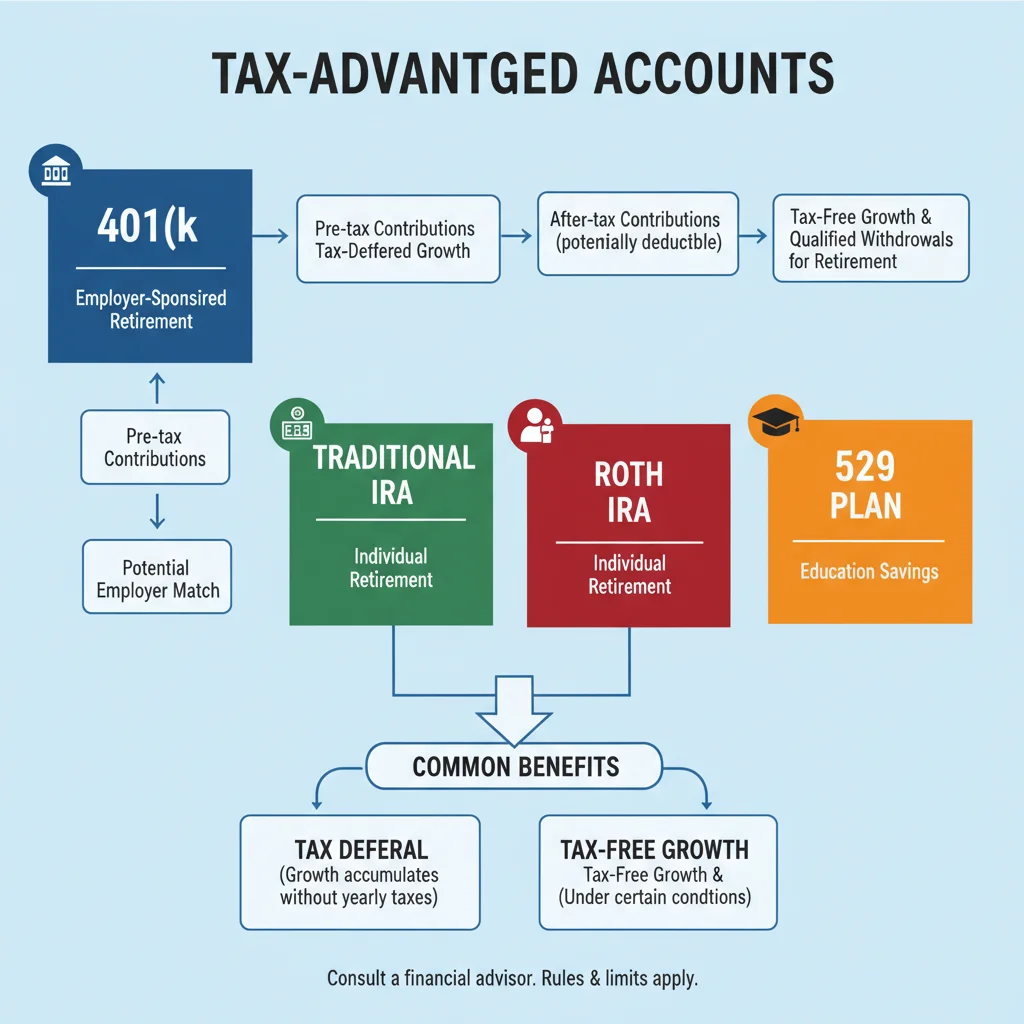
The cornerstone of any effective tax-efficient investing strategy is the judicious use of tax-advantaged accounts. These accounts, sanctioned by governments to encourage saving for specific purposes like retirement or education, offer significant tax benefits that can dramatically boost your after-tax returns. Ignoring these vehicles is akin to leaving free money on the table. For 2026, understanding the nuances of various tax-advantaged accounts and how to best utilize them is crucial.
Retirement Accounts: 401(k)s, IRAs, and Roth IRAs
For most investors, employer-sponsored retirement plans like 401(k)s (and 403(b)s for non-profits) are the first line of defense against investment taxes. Contributions to traditional 401(k)s are typically made with pre-tax dollars, reducing your current taxable income. The investments grow tax-deferred, meaning you don’t pay taxes on capital gains or dividends until you withdraw the money in retirement. This deferral allows your investments to compound more aggressively over time. Many employers also offer a matching contribution, which is essentially a 100% immediate return on your investment – a benefit you should never pass up.
Individual Retirement Accounts (IRAs) offer similar benefits but are self-directed. Traditional IRAs also allow for pre-tax contributions and tax-deferred growth, with withdrawals taxed in retirement. The deductibility of IRA contributions can be phased out for higher earners who are also covered by an employer-sponsored retirement plan. Roth IRAs, on the other hand, operate on an “after-tax” basis. Contributions are made with post-tax dollars, meaning they do not reduce your current taxable income. However, qualified withdrawals in retirement are entirely tax-free. This makes Roth IRAs incredibly powerful for individuals who anticipate being in a higher tax bracket in retirement than they are today.
For 2026, it’s important to be aware of the contribution limits for these accounts, which are often adjusted annually for inflation. Maximizing these contributions should be a priority, especially if your employer offers a match. The choice between a traditional and Roth account often boils down to your current versus anticipated future tax bracket. If you expect your income to rise significantly, a Roth might be more beneficial. If you’re in a high tax bracket now and expect to be in a lower one in retirement, a traditional account could be more advantageous.
Health Savings Accounts (HSAs): The Triple Tax Advantage
Often overlooked, Health Savings Accounts (HSAs) are arguably one of the most powerful tax-efficient investing vehicles available, offering a “triple tax advantage.” To be eligible, you must be enrolled in a High Deductible Health Plan (HDHP). The benefits are:
Tax-deductible contributions: Contributions are made with pre-tax dollars, reducing your taxable income.
Tax-free growth: Investments within the HSA grow tax-free.
Tax-free withdrawals: Qualified withdrawals for eligible medical expenses are entirely tax-free.
If you don’t use the funds for medical expenses, after age 65, you can withdraw them for any purpose, and they will be taxed as ordinary income, similar to a traditional IRA. This flexibility makes HSAs an excellent retirement savings vehicle, particularly if you anticipate significant healthcare costs in your later years (which most people do). For 2026, consider contributing the maximum allowed to an HSA if you are eligible and can afford to pay for current medical expenses out-of-pocket, allowing your HSA funds to grow untouched.
529 Plans for Education Savings
For those saving for education, 529 plans offer a compelling tax-efficient investing solution. Contributions are made with after-tax dollars, but the investments grow tax-free, and qualified withdrawals for educational expenses (tuition, fees, books, room and board, etc.) are also tax-free. Many states also offer a state income tax deduction or credit for contributions to their 529 plans, adding another layer of tax efficiency. As educational costs continue to rise, leveraging a 529 plan can significantly alleviate the financial burden while allowing your savings to grow unhindered by taxes.
Strategy 2: Strategic Asset Location
Beyond simply contributing to tax-advantaged accounts, how you allocate specific types of assets across your taxable and tax-advantaged accounts – a strategy known as asset location – can further enhance your tax-efficient investing efforts. This isn’t about asset allocation (deciding what percentage of your portfolio is in stocks, bonds, etc.), but rather where you hold those assets.
The fundamental principle of asset location is to place investments that generate significant taxable income or have high growth potential in tax-advantaged accounts, while placing assets that are more tax-friendly in taxable accounts. This minimizes the drag of taxes on your most productive investments and allows for greater overall portfolio growth.
Placing Tax-Inefficient Assets in Tax-Advantaged Accounts
Certain investments are inherently less tax-efficient because they generate frequent taxable income or short-term capital gains. These are ideal candidates for tax-advantaged accounts where their income and growth can compound tax-deferred or tax-free.
High-Turnover Funds or Actively Managed Funds: These funds often buy and sell securities frequently, leading to short-term capital gains distributions, which are taxed at ordinary income rates (often higher than long-term capital gains rates). Placing these in a 401(k) or IRA allows them to grow without immediate tax consequences.
Bond Funds: Interest income from bond funds is taxed as ordinary income. Holding these in a tax-deferred account prevents annual taxation on this income, allowing it to reinvest and compound more effectively.
Real Estate Investment Trusts (REITs): REITs often distribute a significant portion of their income as non-qualified dividends or return of capital, which can be taxed at ordinary income rates. They are generally more tax-efficient when held in tax-advantaged accounts.
High-Dividend Stocks: While qualified dividends are taxed at lower capital gains rates, high-dividend stocks still generate annual taxable income. Holding them in a Roth IRA, for example, allows those dividends to be reinvested and grow completely tax-free.
Placing Tax-Efficient Assets in Taxable Accounts
Conversely, some investments are more tax-efficient and can be comfortably held in a taxable brokerage account without incurring excessive tax drag.
Index Funds and ETFs with Low Turnover: Broad-market index funds and Exchange-Traded Funds (ETFs) typically have very low turnover, meaning they buy and sell securities infrequently. This results in minimal capital gains distributions, making them highly tax-efficient for taxable accounts.
Individual Stocks with Long-Term Growth Potential: If you hold individual stocks for the long term (more than a year), any capital gains will be taxed at lower long-term capital gains rates when you eventually sell them. Furthermore, you control when you realize those gains.
Municipal Bonds: Interest income from municipal bonds is generally exempt from federal income tax, and often from state and local taxes if you reside in the issuing state. This makes them highly suitable for taxable accounts, especially for high-income earners.
Considerations for 2026
As you plan for 2026, regularly review your asset location strategy. Changes in tax laws, your income bracket, or your investment objectives might necessitate adjustments. The goal is to minimize the annual tax payments from your investment income, thereby allowing more of your portfolio to compound over time. This strategic placement of assets, when combined with the use of tax-advantaged accounts, forms a powerful duo for tax-efficient investing.
Strategy 3: Harnessing the Power of Tax-Loss Harvesting
Our third crucial strategy for tax-efficient investing involves actively managing your taxable investment portfolio to turn losses into tax savings: tax-loss harvesting. This technique involves selling investments at a loss to offset capital gains and, potentially, a limited amount of ordinary income. It’s a proactive measure that can significantly reduce your tax bill, especially in volatile market conditions.
How Tax-Loss Harvesting Works
When you sell an investment for less than you paid for it, you realize a capital loss. These losses can be used to offset any capital gains you’ve realized from selling other investments at a profit. For example, if you sell stock A for a $10,000 gain and stock B for a $7,000 loss, you can use the $7,000 loss to reduce your taxable gain on stock A to $3,000. This directly reduces your capital gains tax liability.
If your capital losses exceed your capital gains, you can then use up to $3,000 of the net loss to offset your ordinary income (e.g., salary, wages). Any remaining capital losses beyond the $3,000 limit can be carried forward indefinitely to offset future capital gains or ordinary income. This “carryforward” feature makes tax-loss harvesting a powerful tool for long-term tax planning.
Rules and Considerations for 2026
Implementing tax-loss harvesting requires careful attention to IRS rules, particularly the “wash sale rule.” The wash sale rule states that you cannot claim a loss on the sale of a security if you buy a “substantially identical” security within 30 days before or after the sale. This prevents investors from selling a security just to claim a loss and then immediately buying it back, effectively maintaining their position. To avoid a wash sale, you can either wait more than 30 days to repurchase the same security or purchase a different, but similar, security (e.g., an ETF that tracks a different index but has similar exposure) to maintain market exposure.
For 2026, as you review your portfolio, identify any investments that are trading below their purchase price. These “losers” can be strategically sold to generate capital losses. It’s important to remember that tax-loss harvesting should not drive your investment decisions. You shouldn’t sell an investment you believe has strong long-term potential simply to realize a small tax benefit. The primary goal is to optimize your after-tax returns, not just to reduce your tax bill at any cost.
Benefits Beyond Tax Savings
Beyond the immediate tax savings, tax-loss harvesting offers other benefits. It can be an opportunity to rebalance your portfolio, selling underperforming assets and reinvesting the proceeds into more promising investments that align with your long-term strategy. It also encourages regular review of your portfolio, helping you stay engaged with your investments and make necessary adjustments.
Integrating These Strategies for Optimal Tax-Efficient Investing
While each of these three strategies – maximizing tax-advantaged accounts, strategic asset location, and tax-loss harvesting – is powerful on its own, their true potential is unleashed when they are integrated into a cohesive tax-efficient investing plan. Think of it as building a robust financial fortress; each strategy represents a vital wall, and together they create impenetrable protection for your wealth.
A Step-by-Step Approach for 2026
Prioritize Tax-Advantaged Accounts: Your first step should always be to maximize contributions to your 401(k) (especially if there’s an employer match), IRA, Roth IRA, and HSA. These accounts offer the most significant tax benefits and should be funded before considering taxable brokerage accounts. Understand the contribution limits for 2026 and aim to hit them.
Develop an Asset Allocation Plan: Before you even think about asset location, determine your overall asset allocation based on your risk tolerance, time horizon, and financial goals. Decide what percentage of your portfolio should be in stocks, bonds, real estate, etc.
Implement Strategic Asset Location: Once your asset allocation is set, strategically place your investments across your various account types. Put tax-inefficient assets (like bond funds, REITs, high-turnover funds) in tax-deferred or tax-free accounts (401(k), IRA, Roth IRA, HSA). Place tax-efficient assets (like low-cost index funds, ETFs, individual stocks held long-term, municipal bonds) in your taxable brokerage accounts.
Regularly Review and Rebalance: Your portfolio isn’t a “set it and forget it” endeavor. At least once a year, preferably towards the end of the year, review your portfolio. Check if your asset allocation is still appropriate and if your asset location remains optimal. Market movements can shift your percentages, requiring rebalancing.
Proactively Harvest Losses: As part of your annual review, especially if the market has experienced downturns, identify opportunities for tax-loss harvesting. Look for investments in your taxable accounts that are trading at a loss. Sell them to offset gains and up to $3,000 of ordinary income. Remember the wash sale rule and ensure you have a suitable replacement investment if you wish to maintain market exposure.
Stay Informed on Tax Law Changes: Tax laws are not static. Congress can pass new legislation that impacts investment taxes. Stay informed about potential changes for 2026 and beyond. Consulting with a financial advisor or tax professional can be invaluable in navigating these complexities.
The Long-Term Impact of Tax-Efficient Investing
The cumulative effect of these strategies over decades cannot be overstated. Consider two identical portfolios, one managed with a keen eye on tax-efficient investing and the other without. Over 20 or 30 years, the tax-efficient portfolio will likely accumulate significantly more wealth due to reduced tax drag, allowing more of the returns to compound. This difference can amount to hundreds of thousands, or even millions, of dollars, depending on the size of the portfolio and the time horizon.
Furthermore, tax efficiency isn’t just about minimizing taxes; it’s about maximizing control. By strategically managing your tax liabilities, you gain more control over your financial future, allowing you to achieve your retirement goals, fund your children’s education, or pursue other significant life objectives with greater confidence.
Common Pitfalls to Avoid in Tax-Efficient Investing
While the benefits of tax-efficient investing are clear, there are several common pitfalls that investors should be aware of and actively avoid to ensure their strategies remain effective and compliant.
Ignoring the Wash Sale Rule
As mentioned in the tax-loss harvesting section, failing to adhere to the wash sale rule is a frequent mistake. If you sell a security at a loss and then purchase a “substantially identical” security within 30 days before or after the sale, the IRS disallows the loss. This means your attempt to harvest a loss will be futile, and you’ll miss out on the intended tax benefit. Always be mindful of this 61-day window when rebalancing or making new purchases after selling at a loss.
Prioritizing Tax Savings Over Investment Goals
A critical mistake is allowing tax considerations to overshadow your fundamental investment objectives. For instance, holding onto an underperforming asset solely to avoid realizing a capital gain, or selling a high-quality asset for a small tax loss when its long-term prospects are strong, can be detrimental. Your investment decisions should primarily be driven by sound financial principles, diversification, and alignment with your risk tolerance and goals. Tax efficiency should enhance, not dictate, your core investment strategy.
Not Utilizing All Available Tax-Advantaged Accounts
Many investors fail to fully utilize the spectrum of tax-advantaged accounts available to them. This might include not contributing the maximum to a 401(k), especially if an employer match is available, or overlooking the triple tax advantage of an HSA. Each of these accounts serves a unique purpose and offers distinct benefits. Neglecting them means leaving potential tax savings and compounded growth on the table.
Lack of Regular Review and Adjustment
The financial world is dynamic. Tax laws change, market conditions shift, and your personal financial situation evolves. A set-it-and-forget-it approach to tax-efficient investing is likely to become suboptimal over time. Regularly reviewing your portfolio, assessing your asset location, and looking for tax-loss harvesting opportunities (at least annually) is essential. Your strategy for 2026 might need minor tweaks in 2027 or 2028 to remain effective.
Failing to Plan for State and Local Taxes
While federal income taxes often take center stage, state and local taxes can also significantly impact your investment returns. For example, municipal bonds offer federal tax exemption, but their interest might still be subject to state and local taxes unless they are issued within your state of residence. Similarly, state income taxes on capital gains or ordinary income from investments vary widely. A truly comprehensive tax-efficient strategy considers all layers of taxation.
Overcomplicating the Strategy
Sometimes, investors try to implement overly complex strategies that are difficult to manage or understand. While sophistication can be beneficial, unnecessary complexity can lead to errors, increased administrative burden, and potential non-compliance. Start with the foundational strategies discussed – tax-advantaged accounts, asset location, and tax-loss harvesting – and ensure you master them before considering more intricate approaches. Simplicity often leads to greater adherence and better outcomes.
Not Seeking Professional Advice
The world of tax law and investment strategy can be intricate. Attempting to navigate it entirely on your own, especially as your portfolio grows and your financial situation becomes more complex, can lead to missed opportunities or costly mistakes. A qualified financial advisor who specializes in tax planning and investment management can provide personalized guidance, help you optimize your strategies for 2026, and ensure you remain compliant with all relevant regulations. Their expertise can be invaluable in maximizing your after-tax returns.
Conclusion: Empowering Your Financial Future with Tax-Efficient Investing
As we navigate the complexities of 2026 and beyond, the importance of tax-efficient investing cannot be overstated. It is a critical discipline that distinguishes successful long-term investors from those who allow tax drag to silently erode their wealth. By diligently applying the three key strategies – maximizing tax-advantaged accounts, strategically locating your assets, and actively engaging in tax-loss harvesting – you lay a robust foundation for significantly boosting your after-tax returns.
Remember, it’s not just about earning high returns; it’s about keeping a larger portion of those returns to fuel your financial growth. Each dollar saved from taxes is a dollar that can be reinvested, compounding over time to create substantial wealth. The consistent application of these principles, coupled with regular review and adjustment, will empower you to navigate the ever-changing financial landscape with confidence and efficiency.
Take the time now to assess your current investment strategy, identify areas where you can implement these tax-efficient techniques, and consider consulting with a financial professional to tailor a plan that aligns perfectly with your unique circumstances and aspirations. Your future financial self will thank you for the proactive steps you take today in mastering the art of tax-efficient investing. Embrace these strategies, and unlock the full potential of your investment portfolio for a more prosperous future.
Lara Barbosa has a degree in Journalism, with experience in editing and managing news portals. Her approach combines academic research and accessible language, turning complex topics into educational materials of interest to the general public.