Small-Cap vs. Large-Cap Stocks: 2026 Investment Potential Analysis
This article delves into the enduring debate of small-cap vs. large-cap stocks, analyzing their performance, risks, and rewards. We provide a forward-looking perspective to 2026, helping investors make informed decisions for their portfolios.
By: Lara Barbosa on February 13, 2026
Last updated on: July 31, 2026
Small-Cap vs. Large-Cap Stocks: 2026 Investment Potential Analysis
Investing in the stock market can be a daunting yet rewarding endeavor. For seasoned investors and novices alike, a fundamental decision often revolves around allocating capital between small-cap and large-cap stocks. This choice isn’t merely about company size; it’s about embracing different risk profiles, growth potentials, and market dynamics. As we look towards 2026, the global economic landscape continues to evolve, presenting new challenges and opportunities that could significantly impact how these two categories perform. Understanding the nuances of small-cap vs. large-cap stocks is crucial for crafting a resilient and profitable investment portfolio.
The debate over which category offers superior returns is perennial, with historical data often showing periods where one outperforms the other. Small-cap stocks, typically characterized by smaller market capitalizations, are often associated with higher growth potential but also increased volatility and risk. Large-cap stocks, on the other hand, represent established companies with significant market shares, offering greater stability, consistent dividends, and often, a degree of resilience during economic downturns. However, their growth potential might be more subdued compared to their smaller counterparts.
Our objective in this comprehensive guide is to dissect the characteristics, advantages, and disadvantages of both small-cap and large-cap stocks. We will analyze their historical performance, delve into the factors that influence their returns, and critically assess their investment potential as we project forward to 2026. What market conditions might favor small-caps? When should investors lean towards large-caps? How can strategic allocation across both categories optimize portfolio performance? These are some of the key questions we aim to answer, providing you with actionable insights to navigate the complexities of the stock market.
The next five years promise to be dynamic, shaped by technological advancements, geopolitical shifts, changing consumer behaviors, and evolving monetary policies. Each of these elements can disproportionately affect small-cap vs. large-cap stocks. Therefore, a forward-looking perspective, grounded in a thorough understanding of market fundamentals and emerging trends, is indispensable. By the end of this article, you will have a clearer picture of which investment path might align best with your financial goals and risk tolerance in the years leading up to 2026.
Defining Small-Cap and Large-Cap Stocks: The Fundamentals
Before we embark on a comparative analysis of small-cap vs. large-cap stocks, it’s essential to establish a clear understanding of what defines each category. While there isn’t a universally agreed-upon precise cutoff, market capitalization is the primary metric used for classification. Market capitalization is calculated by multiplying a company’s share price by the number of its outstanding shares.
What are Small-Cap Stocks?
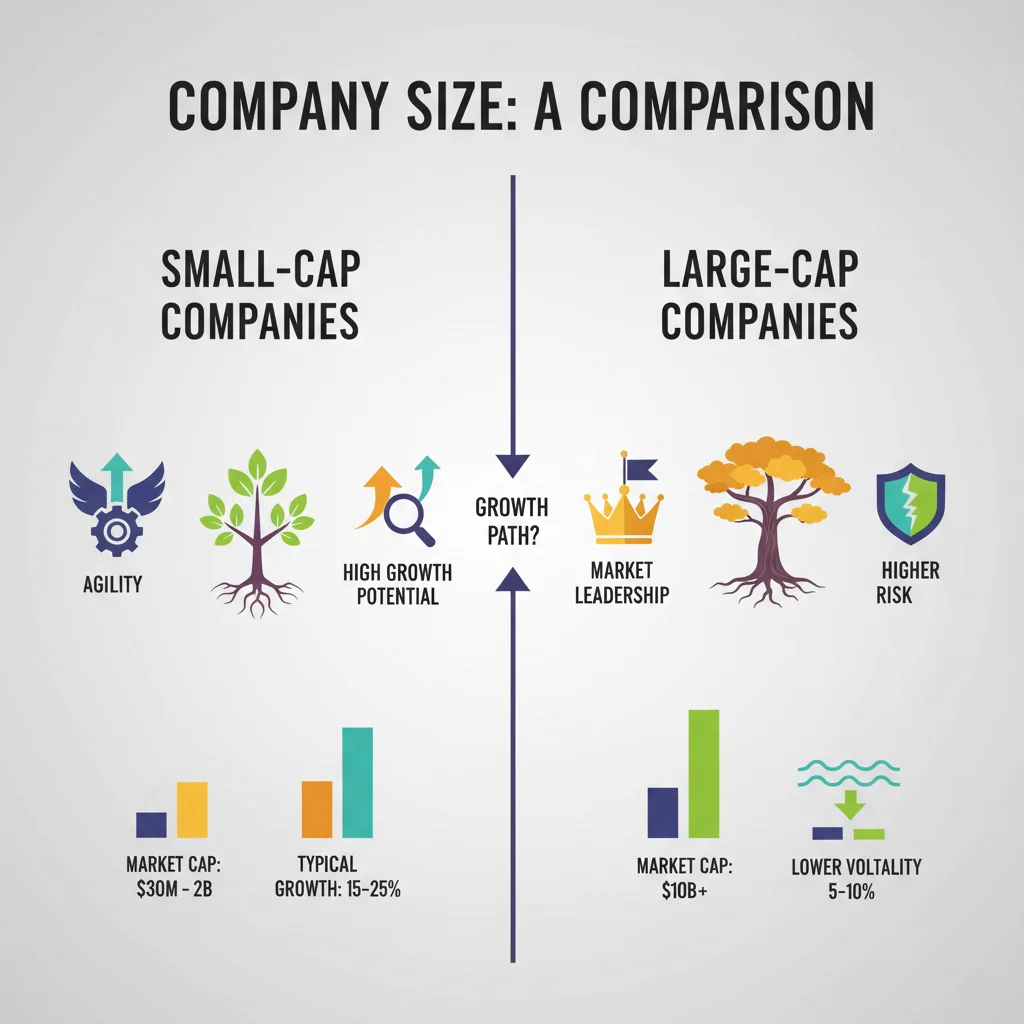
Small-cap stocks typically refer to companies with a market capitalization ranging from $300 million to $2 billion. These companies are often younger, operate in niche markets, or are in the early to mid-stages of their growth cycle. They might be innovators in emerging industries or smaller players seeking to disrupt established markets. Examples could include biotech startups, specialized tech firms, or regional businesses with strong growth prospects.
Characteristics of Small-Cap Stocks:
Higher Growth Potential: Due to their smaller size, small-cap companies have more room to grow rapidly. A new product or service can have a more significant impact on their revenue and profitability compared to a large, established corporation.
Greater Volatility: With higher growth potential comes increased risk and volatility. Small-cap companies are often more susceptible to economic downturns, competitive pressures, and changes in consumer sentiment. Their stock prices can experience wider swings than those of large-cap companies.
Less Analyst Coverage: Small-cap stocks generally receive less attention from institutional analysts compared to large-caps. This can mean that their true value might be overlooked by the broader market, potentially presenting opportunities for astute investors who conduct thorough research.
Liquidity Concerns: The trading volume for small-cap stocks can be lower, leading to less liquidity. This means it might be harder to buy or sell large blocks of shares without significantly impacting the stock price.
Sensitivity to Interest Rates: Small-cap companies often rely more on external financing for growth, making them more sensitive to changes in interest rates.
What are Large-Cap Stocks?
Large-cap stocks represent well-established, often household-name companies with market capitalizations typically exceeding $10 billion. These are the giants of industry, leaders in their respective sectors, with extensive operations, global reach, and often a long history of profitability. Think of companies like Apple, Microsoft, Amazon, or Johnson & Johnson.
Characteristics of Large-Cap Stocks:
Stability and Resilience: Large-cap companies are generally more stable and resilient, especially during economic downturns. Their diversified revenue streams, strong balance sheets, and established market positions provide a cushion against adverse market conditions.
Lower Volatility: While not immune to market fluctuations, large-cap stocks tend to exhibit lower volatility compared to small-caps. Their stock prices are generally more predictable.
Consistent Dividends: Many large-cap companies have a history of paying consistent dividends, providing investors with a steady income stream in addition to potential capital appreciation.
Extensive Analyst Coverage: These companies are closely watched by numerous analysts, meaning that information is widely available, and their valuations are often well-understood by the market.
Higher Liquidity: Large-cap stocks are highly liquid, with high trading volumes, making it easy to buy and sell shares without significant price impact.
Slower Growth Potential: While they continue to grow, the sheer size of large-cap companies means their percentage growth rates might not match the explosive potential of smaller, emerging firms.
Understanding these fundamental distinctions is the first step in appreciating the different roles small-cap vs. large-cap stocks can play in an investment portfolio. Each category caters to different investment objectives and risk appetites, and a balanced approach often involves a strategic blend of both.
Historical Performance: Small-Cap vs. Large-Cap Stocks
The historical performance of small-cap vs. large-cap stocks provides valuable context for their future potential. Over long periods, both categories have demonstrated their ability to generate returns, but their paths and magnitudes of return have often differed, influenced by various economic cycles and market conditions.
The Small-Cap Premium
Historically, academic research and market data have often pointed to a phenomenon known as the ‘small-cap premium.’ This suggests that, over very long time horizons, small-cap stocks have tended to outperform large-cap stocks. The rationale behind this premium often includes:
Higher Growth Trajectory: As discussed, smaller companies have more room to grow exponentially. A successful product launch or market expansion can significantly boost their value.
Inefficiencies in Pricing: Due to less analyst coverage and lower liquidity, small-cap stocks might be more prone to mispricing, allowing savvy investors to uncover undervalued gems.
Risk Compensation: The higher risk and volatility associated with small-caps are compensated by potentially higher returns for investors willing to bear that risk.
However, it’s crucial to note that this premium is not constant and can be cyclical. There have been extended periods where large-cap stocks have significantly outperformed small-caps, especially during times of economic uncertainty or when investors flock to the safety and liquidity of larger, more established companies.
Large-Cap Stability and Dividend Income
While small-caps might offer higher growth potential, large-cap stocks have their own distinct advantages that contribute to their appeal. Their stability and often consistent dividend payouts make them attractive to investors seeking income and lower volatility.
Bear Market Resilience: During market downturns, large-cap companies often demonstrate greater resilience. Their robust balance sheets, diversified operations, and access to capital markets help them weather economic storms better than smaller firms.
Consistent Income: Many large-cap companies are ‘dividend aristocrats’ or ‘dividend kings,’ meaning they have consistently increased their dividends for many years. This provides a reliable income stream, which can be particularly appealing to retirees or income-focused investors.
Liquidity and Ease of Trading: The high liquidity of large-cap stocks ensures that investors can easily enter and exit positions, which is a significant advantage in rapidly changing market conditions.
Recent Trends and Cyclical Performance
Looking at recent history, the performance pendulum has swung between small-cap vs. large-cap stocks. For instance, in periods of strong economic expansion, small-caps often thrive as businesses expand and consumer spending increases. Conversely, during periods of economic contraction or uncertainty, investors tend to favor the perceived safety of large-caps.
The post-pandemic recovery, for example, saw a significant surge in certain small-cap sectors, particularly those aligned with digital transformation and innovative technologies. However, as inflation concerns and interest rate hikes emerged, the market saw a shift, with investors re-evaluating risk and often moving towards the more stable large-cap companies. Understanding these cyclical patterns is vital for strategic asset allocation.
It’s important for investors not to solely rely on past performance as an indicator of future results. While history provides valuable lessons, the future market environment, especially looking towards 2026, will be shaped by unique factors that require careful consideration.
Factors Influencing Small-Cap vs. Large-Cap Performance Towards 2026
As we project the investment potential of small-cap vs. large-cap stocks towards 2026, several macroeconomic, technological, and geopolitical factors will play a pivotal role. A nuanced understanding of these influences is critical for making informed investment decisions.
Economic Growth and Interest Rates
The overall pace of economic growth is a significant determinant. In periods of robust economic expansion, small-cap companies tend to outperform. Their revenues and profits are often more sensitive to domestic economic activity, and they can capitalize quickly on new opportunities. Conversely, a sluggish economy might favor large-cap stocks, as their global reach and diversified operations can provide a buffer against regional slowdowns.
Interest rates are another crucial factor. Small-cap companies often rely more heavily on borrowing for growth and expansion. Therefore, a rising interest rate environment can increase their cost of capital, potentially dampening their growth prospects and profitability. Large-cap companies, with their stronger balance sheets and greater access to diverse funding sources, may be less affected, or in some cases, even benefit from higher rates if they are in sectors like banking or insurance.
Looking towards 2026, central bank policies regarding inflation and interest rates will be paramount. If inflation remains elevated, prompting further rate hikes, it could pose headwinds for small-cap growth. Conversely, a return to lower rates could reignite interest in higher-growth small-cap opportunities.
Technological Innovation and Disruption
Technological innovation is a relentless force reshaping industries. Small-cap companies are often at the forefront of disruptive technologies, driving innovation in areas like artificial intelligence, biotechnology, renewable energy, and advanced materials. These companies, if successful, can experience explosive growth, transforming into tomorrow’s large-caps.
However, large-cap companies are not immune to technological shifts. Many are actively investing in R&D, acquiring innovative small-caps, or adapting their business models to leverage new technologies. The ability of large-caps to integrate new technologies and maintain their competitive edge will be crucial. The rapid evolution of AI, for instance, could significantly impact both categories – creating new opportunities for nimble small-caps and efficiency gains for established large-caps.
Geopolitical Landscape and Supply Chains
The geopolitical environment, including trade policies, international relations, and regional conflicts, can have profound effects on global markets. Large-cap companies, with their multinational operations and complex supply chains, are particularly susceptible to geopolitical tensions and disruptions. Supply chain resilience has become a critical consideration post-pandemic, and companies that have successfully diversified their supply chains may fare better.
Small-cap companies, especially those focused on domestic markets, might be less directly impacted by international trade disputes. However, they can still be affected by broader economic uncertainty or changes in domestic policy driven by geopolitical events. The ongoing tensions and shifts in global alliances will undoubtedly influence investment flows and risk perceptions towards 2026.
Regulatory Environment and ESG Factors
Changes in regulatory frameworks can create both opportunities and challenges. New regulations in areas like environmental protection, data privacy, or antitrust can disproportionately affect certain industries or company sizes. Small-cap companies, with fewer resources, might find it more challenging to comply with complex regulations. Large-caps, while having the resources, could face increased scrutiny due to their market dominance.
Environmental, Social, and Governance (ESG) factors are also gaining increasing prominence. Investors are increasingly considering a company’s ESG performance when making investment decisions. While many large-cap companies have dedicated ESG initiatives and reporting, small-caps are often under pressure to demonstrate their commitment to sustainability and ethical practices to attract capital. Companies that align with evolving ESG standards are likely to see increased investor interest by 2026.
Considering these diverse factors, investors need to adopt a dynamic approach when assessing the relative merits of small-cap vs. large-cap stocks. The market environment of 2026 will likely reward adaptability and a deep understanding of these underlying forces.
Strategic Allocation: Balancing Small-Cap and Large-Cap Stocks
The question isn’t necessarily whether small-cap vs. large-cap stocks are ‘better’ but rather how to strategically allocate between them to achieve your financial objectives. A well-diversified portfolio often includes a mix of both, leveraging the strengths of each category while mitigating their respective weaknesses.
Understanding Your Risk Tolerance
Your personal risk tolerance is a fundamental determinant of your allocation strategy. If you have a higher risk tolerance and a longer investment horizon, you might be comfortable allocating a larger portion of your portfolio to small-cap stocks, aiming for higher growth. Conversely, if you are more risk-averse or nearing retirement, a greater allocation to large-cap stocks might be more appropriate, prioritizing stability and income.
It’s important to conduct an honest assessment of how much volatility you can stomach. While small-caps offer tantalizing growth, their sharp downturns can be unsettling for some investors. Large-caps, with their smoother ride, can provide peace of mind even if their upside is more limited.
Diversification Benefits
One of the primary benefits of investing in both small-cap vs. large-cap stocks is diversification. These two categories often perform differently under various market conditions. When one is underperforming, the other might be thriving, helping to smooth out overall portfolio returns. This non-correlation or low correlation between their movements can reduce overall portfolio risk.
For example, during periods of economic expansion, small-caps might lead the market, while in times of contraction or uncertainty, large-caps might act as a defensive anchor. A balanced portfolio ensures that you are positioned to benefit from both scenarios, rather than being overly exposed to the cyclical fortunes of a single category.
Core-Satellite Approach
Many investors adopt a ‘core-satellite’ approach to portfolio construction. The ‘core’ typically consists of stable, large-cap investments that provide a solid foundation and consistent returns. These are often broad market index funds or ETFs that track the S&P 500 or other large-cap indices.
The ‘satellite’ portion of the portfolio is then allocated to higher-growth, potentially higher-risk assets, such as small-cap stocks. This allows investors to pursue alpha (outperformance relative to a benchmark) through targeted investments in smaller companies, without compromising the overall stability of their portfolio. The size of the satellite allocation depends heavily on individual risk tolerance and investment goals.
Sector-Specific Considerations
Beyond market capitalization, sector analysis is also crucial. Certain sectors are predominantly populated by small-cap companies (e.g., emerging biotech, niche software), while others are dominated by large-caps (e.g., established consumer staples, mature industrials). Understanding sector-specific trends and their alignment with economic forecasts for 2026 can further refine your allocation strategy.
For instance, if you anticipate significant growth in innovative technologies, you might look for small-cap companies within those cutting-edge sectors. If you foresee a period of economic uncertainty, a heavier weighting in defensive large-cap sectors like healthcare or utilities might be prudent.
Active vs. Passive Management
The choice between active and passive management also plays a role. For large-cap stocks, passive investing through broad market index funds (e.g., S&P 500 ETFs) is often recommended due to the efficiency and extensive analyst coverage of these companies. Beating the market consistently with large-caps can be challenging for active managers after fees.
For small-cap stocks, however, active management can potentially add more value. Due to less analyst coverage and greater market inefficiencies, skilled active managers might be able to identify undervalued small-cap gems that the broader market has overlooked. This isn’t a guarantee, but the opportunity for outperformance is often considered greater in the small-cap space.
Ultimately, the optimal allocation between small-cap vs. large-cap stocks is a personalized decision that should align with your financial situation, investment horizon, and comfort level with risk. Regular review and rebalancing of your portfolio are essential to ensure it remains aligned with your objectives as market conditions and your personal circumstances evolve.
The 2026 Outlook: Which Category Might Lead?
Forecasting market performance is inherently challenging, but by analyzing current trends and anticipated developments, we can form a reasonable outlook for small-cap vs. large-cap stocks towards 2026. Several scenarios could unfold, each favoring a different investment approach.
Scenario 1: Strong Economic Recovery and Innovation Boom
If the global economy experiences a sustained, robust recovery, characterized by stable inflation, moderate interest rates, and strong consumer and business confidence, small-cap stocks could be poised for significant outperformance. In this scenario, innovative small-cap companies, particularly those in high-growth sectors like biotechnology, artificial intelligence, clean energy, and specialized software, would thrive. Their agility and ability to capitalize on new market opportunities would be a major advantage. Investors would likely favor growth over value, and the small-cap premium could reassert itself.
Large-cap stocks would still perform well in this environment, but their growth might be more measured. They would benefit from increased consumer spending and business activity, but their sheer size could limit their percentage gains compared to their smaller counterparts. However, large-cap technology giants and established global brands would continue to generate strong earnings and potentially offer attractive dividends.
Scenario 2: Moderate Growth with Persistent Inflation and Higher Rates
Should the economy experience moderate growth but grapple with persistent inflation and higher-than-historical interest rates, the landscape could shift. In such a scenario, large-cap stocks, especially those with strong pricing power, robust balance sheets, and consistent cash flows, might be the preferred choice. Companies in defensive sectors like consumer staples, utilities, and healthcare, which tend to be large-cap dominant, could offer stability and dividend income, appealing to investors seeking refuge from economic uncertainty.
Small-cap stocks, particularly those reliant on debt financing, could face headwinds due to higher borrowing costs. Their valuations might come under pressure, and only the most resilient and profitable small-caps would thrive. Investors would likely become more selective, focusing on small-cap companies with proven business models and strong competitive advantages, rather than speculative growth plays.
Scenario 3: Market Volatility and Geopolitical Uncertainty
A period marked by increased market volatility, geopolitical instability, or unforeseen global events could lead investors to prioritize safety and liquidity. In this environment, large-cap stocks would likely outperform. Their perceived safety, extensive analyst coverage, and deep liquidity would make them attractive during times of stress. Investors would flock to established companies with global footprints and diversified revenue streams, which are better equipped to absorb shocks.
Small-cap stocks, being more sensitive to market sentiment and economic shocks, could experience more significant drawdowns. While opportunities might emerge for contrarian investors, the overall trend would likely favor large-caps as a safe haven. This scenario would underscore the importance of diversification and a well-balanced portfolio, with large-caps forming a defensive core.
The Role of Specific Sectors
Beyond the broad categories of small-cap vs. large-cap stocks, specific sectors will also dictate performance. For instance, the continued digitalization of the economy could favor tech-oriented small-caps, but also benefit large-cap tech giants. The transition to clean energy could propel both small-cap innovators and large-cap industrial companies adapting their operations.
Healthcare, regardless of economic conditions, tends to be a resilient sector, with both small-cap biotech firms and large-cap pharmaceutical companies offering investment potential. Understanding these sector-specific dynamics within the broader small-cap vs. large-cap debate will be crucial for identifying winning investments towards 2026.
Ultimately, a flexible and adaptable investment strategy will be key. Investors should continuously monitor economic indicators, market trends, and their own financial goals, adjusting their allocation between small-cap vs. large-cap stocks as circumstances evolve. While the small-cap premium might reassert itself in a strong growth environment, the stability and resilience of large-caps will always hold value, particularly during uncertain times.
Conclusion: Navigating the Future of Small-Cap vs. Large-Cap Investments
The journey through the world of small-cap vs. large-cap stocks reveals a landscape rich with diverse opportunities and inherent risks. There is no single ‘best’ category; rather, the optimal investment strategy lies in understanding the unique characteristics of each, aligning them with your personal financial goals and risk tolerance, and adapting your approach to prevailing market conditions.
As we look forward to 2026, the global economy promises to be dynamic and complex. Factors such as interest rate policies, inflation trends, technological advancements, geopolitical stability, and evolving regulatory environments will collectively shape the performance of both small-cap and large-cap segments. Small-cap stocks, with their potential for explosive growth and the allure of discovering the next market disruptor, will continue to attract investors seeking higher returns. However, this potential comes hand-in-hand with increased volatility and risk, demanding thorough research and a patient investment horizon. Their sensitivity to economic cycles and access to capital means they thrive during periods of robust economic expansion and stable financial conditions.
Conversely, large-cap stocks offer a bastion of stability, resilience, and often, reliable income through dividends. These established market leaders, with their diversified operations and strong balance sheets, are better equipped to weather economic downturns and geopolitical uncertainties. While their growth trajectory might be more moderate, their consistency and liquidity make them indispensable components of a balanced portfolio, particularly for risk-averse investors or those seeking steady income streams.
The most prudent approach for navigating the investment landscape towards 2026 involves a strategic blend of both small-cap vs. large-cap stocks. A diversified portfolio that incorporates a ‘core’ of stable large-cap holdings and ‘satellite’ allocations to high-potential small-caps can optimize for both growth and stability. This strategy allows investors to capture the upside potential of emerging companies while benefiting from the defensive qualities of market giants. Regular portfolio rebalancing is crucial to ensure that your allocation remains aligned with your investment objectives and adapts to shifts in market sentiment and economic realities.
Furthermore, investors should remain vigilant about sector-specific trends and the broader macroeconomic environment. The rise of new technologies, the imperative for sustainable practices, and shifts in consumer behavior will create specific opportunities and challenges across various industries, impacting both small-cap and large-cap companies within those sectors. Engaging in continuous learning, staying informed about global developments, and consulting with financial advisors can further enhance your decision-making process.
In conclusion, whether small-cap or large-cap stocks offer ‘better’ investment potential in 2026 will largely depend on the specific economic conditions that unfold and your individual investment philosophy. By understanding the strengths and weaknesses of each category, adopting a diversified and adaptable strategy, and maintaining a forward-looking perspective, investors can confidently position their portfolios for success in the years to come.
Lara Barbosa has a degree in Journalism, with experience in editing and managing news portals. Her approach combines academic research and accessible language, turning complex topics into educational materials of interest to the general public.