Unlock Financial Growth: The Power of Compounding Explained
Explore the power of compounding, a fundamental principle for wealth accumulation. This guide delves into its mechanics, benefits, and practical strategies for maximizing your financial growth over the long term.
By: Lara Barbosa on July 6, 2026
Last updated on: July 31, 2026
In the vast and often complex world of finance, few principles hold as much transformative potential as the power of compounding. Often hailed as the ‘eighth wonder of the world’ by Albert Einstein, compounding is not just a mathematical concept; it’s a fundamental engine for wealth creation that can dramatically accelerate your financial journey. Understanding and harnessing this power is crucial for anyone looking to achieve significant financial growth, whether you’re saving for retirement, a down payment, or simply building a more secure future.
At its core, compounding is the process of earning returns not only on your initial investment but also on the accumulated interest from previous periods. It’s interest earning interest, creating a snowball effect that gathers momentum and size over time. While the initial gains might seem modest, the cumulative effect over years, or even decades, can be truly astonishing. This article will delve deep into the mechanics of the power of compounding, illustrate its profound impact with practical examples, and provide actionable strategies to help you leverage it effectively for your financial goals.
What Exactly is the Power of Compounding?
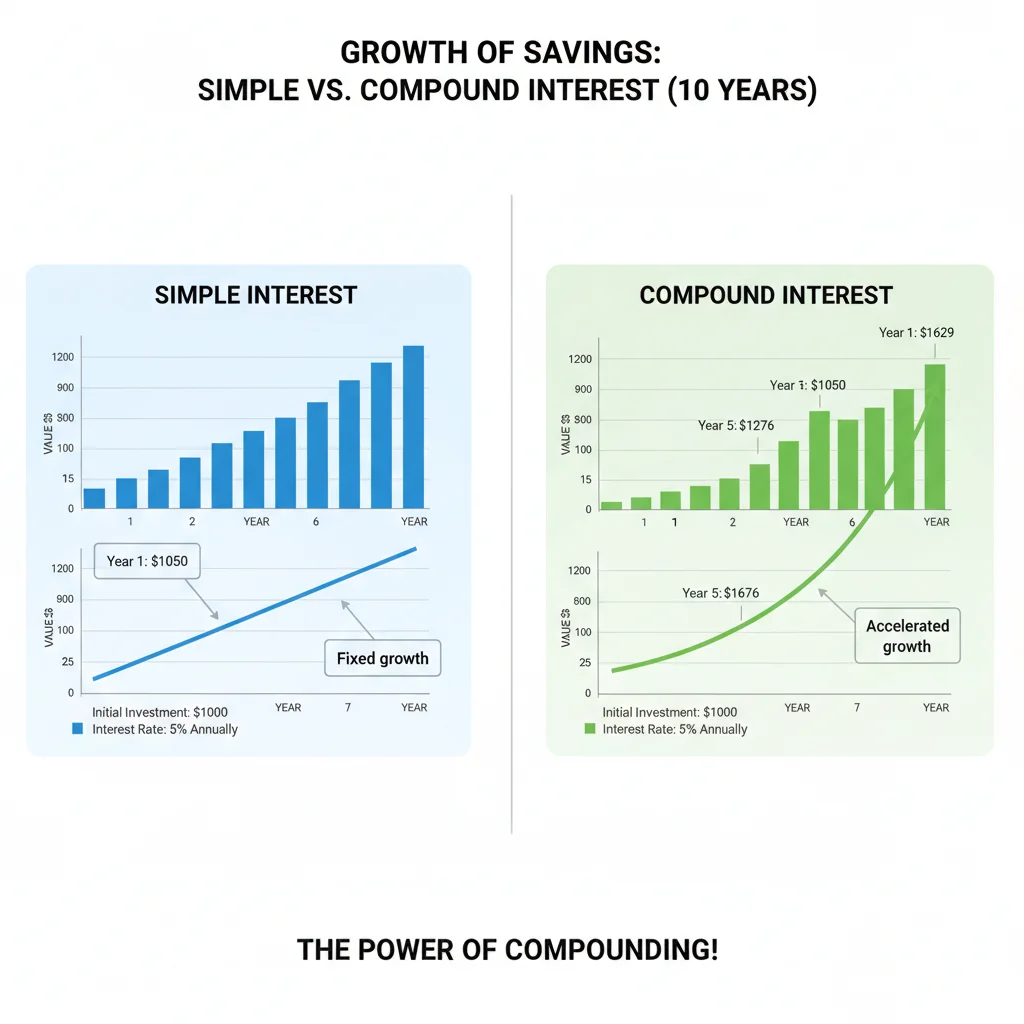
To truly appreciate the power of compounding, let’s break down its definition and contrast it with simple interest. Simple interest is calculated only on the principal amount of a loan or deposit. For example, if you invest $1,000 at a 5% simple interest rate, you’d earn $50 each year, and your investment would grow linearly.
Compounding, however, takes a different approach. With compound interest, the interest earned in one period is added to the principal, and then the next period’s interest is calculated on this new, larger principal. This recursive process means your money starts working harder for you with each passing period. The formula for compound interest is: A = P(1 + r/n)^(nt), where:
A = the future value of the investment/loan, including interest
P = the principal investment amount (the initial deposit or loan amount)
r = the annual interest rate (as a decimal)
n = the number of times that interest is compounded per year
t = the number of years the money is invested or borrowed for
While the formula might look intimidating, the underlying concept is beautifully simple: your earnings generate further earnings. This exponential growth is what makes the power of compounding so potent.
The Snowball Effect: How Compounding Builds Wealth
Imagine a small snowball rolling down a hill. Initially, it’s tiny, but as it rolls, it picks up more snow, growing larger and gaining speed. This is an apt metaphor for how compound interest works. The longer your money is invested and allowed to compound, the more significant the impact becomes. This snowball effect is particularly noticeable over extended periods.
Let’s consider a hypothetical example to illustrate this. Suppose you invest $10,000 at an annual interest rate of 7%, compounded annually:
Year 1: You earn $700 in interest ($10,000 * 0.07). Your total becomes $10,700.
Year 2: You earn interest on $10,700, which is $749 ($10,700 * 0.07). Your total becomes $11,449.
Year 3: You earn interest on $11,449, which is $801.43 ($11,449 * 0.07). Your total becomes $12,250.43.
Notice how the interest earned increases each year, even though the interest rate remains constant. This acceleration is the undeniable power of compounding at play. Over 10, 20, or even 30 years, this difference becomes truly substantial, turning modest initial investments into significant sums.
Time: The Ultimate Ally of Compounding
The single most crucial factor in maximizing the power of compounding is time. The earlier you start investing, the longer your money has to grow exponentially. This concept is often referred to as “time in the market, not timing the market.” Even small, consistent contributions made early in life can outperform larger contributions made later, simply because of the extended compounding period.
Consider two individuals, Alice and Bob, both investing $5,000 annually at an average annual return of 8%:
Alice: Starts investing at age 25 and stops at age 35 (10 years of contributions). Total invested: $50,000.
Bob: Starts investing at age 35 and continues until age 65 (30 years of contributions). Total invested: $150,000.
By age 65, Alice, who invested less money over a shorter period but started earlier, will likely have a significantly larger nest egg than Bob. This is because Alice’s initial contributions had an extra 20 years to compound, allowing her money to grow much more substantially. This stark example underscores why “starting early” is the golden rule of investing when leveraging the power of compounding.
Frequency of Compounding: More is Better
While time is paramount, the frequency at which interest is compounded also plays a significant role in the overall growth of your investment. Interest can be compounded annually, semi-annually, quarterly, monthly, daily, or even continuously. The more frequently interest is compounded, the faster your investment will grow, albeit the difference might be less dramatic than the impact of time.
For instance, an investment compounded daily will generally grow slightly faster than one compounded annually, assuming the same interest rate. This is because the interest is added to the principal more often, leading to a quicker re-calculation of the base for future interest earnings. When evaluating investment opportunities, always consider the compounding frequency, as it directly influences the true annual percentage yield (APY) of your investment.
Real-World Applications of the Power of Compounding
The power of compounding isn’t just an abstract financial theory; it’s a practical tool that can be applied across various financial vehicles:
1. Retirement Accounts (401(k)s, IRAs)
These are perhaps the most common and effective ways to harness compounding. Contributions to these accounts are invested, and the earnings grow tax-deferred or tax-free, allowing for uninterrupted compounding. The long-term nature of retirement planning perfectly aligns with the exponential growth potential of compound interest.
2. Stock Market Investments
Investing in stocks, mutual funds, or exchange-traded funds (ETFs) allows your capital to grow through capital appreciation and dividends. If dividends are reinvested, they buy more shares, which then generate more dividends, creating a powerful compounding loop. Over decades, this can lead to substantial wealth accumulation.
3. High-Yield Savings Accounts and Certificates of Deposit (CDs)
While offering lower returns than the stock market, these accounts still benefit from compounding, especially over shorter to medium terms. The interest earned is regularly added to your principal, increasing your overall savings.
4. Reinvested Dividends
Many companies pay dividends to shareholders. Choosing to reinvest these dividends means using the payout to purchase more shares of the same stock or fund. This strategy significantly amplifies the power of compounding, as your ownership grows without additional out-of-pocket contributions.
5. Debt Management (The Reverse Compounding Effect)
While positive for investments, compounding works against you with debt, especially high-interest debt like credit cards. The interest on your outstanding balance is added to the principal, and then you pay interest on that new, larger amount. This “reverse compounding” can quickly spiral out of control, making debt repayment extremely challenging. Understanding this negative aspect of compounding emphasizes the importance of paying off high-interest debt promptly.
Strategies to Maximize the Power of Compounding
Leveraging the power of compounding effectively requires a strategic approach. Here are some key strategies to help you maximize its benefits:
1. Start Early and Be Consistent
As discussed, time is your greatest asset. Begin investing as soon as possible, even if it’s a small amount. Consistency is equally important; regular contributions, no matter how modest, ensure your investment pot continues to grow and compound.
2. Reinvest Your Earnings
To truly unleash the full potential of compounding, always opt to reinvest any dividends, interest, or capital gains you receive. This ensures that your earnings are immediately put back to work, generating even more returns.
3. Choose Investments with Solid Growth Potential
While guaranteed returns are rare, selecting investments that historically offer reasonable average annual returns (like diversified stock market funds) will significantly enhance your compounding results. Higher returns, even by a few percentage points, make a massive difference over long periods.
4. Minimize Fees and Taxes
High fees and taxes can eat into your returns, effectively reducing the amount available for compounding. Opt for low-cost index funds or ETFs, and utilize tax-advantaged accounts (like 401(k)s, IRAs, HSAs) to protect your gains from annual taxation, allowing them to compound more efficiently.
5. Be Patient and Resist the Urge to “Market Time”
Compounding works best over the long haul. Market fluctuations are normal, but trying to buy low and sell high often leads to missing out on significant growth periods. A “set it and forget it” approach, coupled with periodic rebalancing, is often more effective than active trading for long-term compounding.
6. Increase Contributions Over Time
As your income grows, try to increase your investment contributions. Even a small annual increase can significantly boost your final compounded total. Many retirement plans offer an “auto-increase” feature, allowing your contributions to rise automatically each year.
The Psychological Aspect of Compounding
Beyond the numbers, the power of compounding also has a significant psychological impact. Witnessing your money grow, seemingly on its own, can be incredibly motivating. It reinforces good financial habits and encourages continued saving and investing. Conversely, ignoring compounding can lead to missed opportunities and a feeling of being perpetually behind financially.
Understanding that early sacrifices in spending can lead to substantial future gains through compounding helps build financial discipline. It shifts the perspective from instant gratification to long-term prosperity, a crucial mindset for successful wealth building.
Common Misconceptions About Compounding
Despite its widespread recognition, there are still some common misunderstandings about the power of compounding:
1. It’s Only for the Wealthy
Absolutely not. Compounding benefits everyone, regardless of their starting capital. Even small, consistent investments of $50 or $100 per month can grow into substantial sums over decades, especially for young investors.
2. It Requires High Returns
While higher returns accelerate growth, compounding works even with modest returns. The key is consistency and time. A steady 5-7% return over 30-40 years can be far more impactful than chasing risky, high-return investments that might fail.
3. It’s a “Get Rich Quick” Scheme
Compounding is the antithesis of a get-rich-quick scheme. It’s a slow, steady, and predictable method of wealth accumulation that rewards patience and discipline. Its power becomes truly evident only after many years.
4. It’s Only About Investments
While often discussed in investment contexts, the principle of compounding applies to other areas of life too. For example, compounding knowledge (learning new skills building on existing ones) or compounding good habits (small daily improvements leading to significant long-term results) operate on similar principles.
Calculating Your Compounding Potential
While the formula can be used, many online calculators can help you visualize the power of compounding for your specific scenario. Input your initial investment, regular contributions, expected annual return, and time horizon, and these tools will project your future wealth. Experimenting with different variables can be an eye-opening exercise, demonstrating the profound impact of starting early or increasing your contributions.
For example, using a simple compound interest calculator, you can see how an initial $5,000 investment, with an additional $200 contributed monthly, earning an average of 8% annually, could grow to over $300,000 in 30 years. Without the monthly contributions, the initial $5,000 would only grow to about $50,000. This stark contrast highlights the importance of consistent contributions alongside the compounding effect.
The Ethical Dimension of Compounding
It’s also worth considering the ethical implications of the power of compounding. While it’s a powerful tool for individual wealth creation, its large-scale impact can contribute to wealth disparities if access to investment opportunities is uneven. Financial literacy and equitable access to investment vehicles are crucial to ensure that more people can benefit from this fundamental principle of growth.
As individuals, we have the opportunity to use our compounded wealth responsibly, whether through philanthropic endeavors, supporting sustainable businesses, or investing in community development. The financial freedom gained through compounding can empower individuals to make choices that benefit not only themselves but also society at large.
Conclusion: Embrace the Power of Compounding
The power of compounding is arguably the most essential concept for anyone serious about building long-term wealth. It transforms small, consistent efforts into significant financial gains over time. By understanding its mechanics, starting early, being consistent with contributions, reinvesting earnings, and minimizing costs, you can harness this “eighth wonder” to achieve your financial aspirations.
Don’t underestimate the seemingly small differences in early stages; they are the foundation for exponential growth. Embrace patience, maintain discipline, and allow time to work its magic. The journey to financial independence is often a marathon, not a sprint, and compounding is the steady, accelerating pace that will carry you across the finish line. Start today, and watch the incredible power of compounding transform your financial future.
Lara Barbosa has a degree in Journalism, with experience in editing and managing news portals. Her approach combines academic research and accessible language, turning complex topics into educational materials of interest to the general public.