Maximize Roth IRA 2026: Smart Strategies for Retirement Growth
Discover how to maximize your Roth IRA contributions in 2026. This guide covers contribution limits, income phase-outs, backdoor Roth strategies, and essential tips for leveraging this powerful retirement vehicle for substantial long-term, tax-free growth.
By: Matheus Neiva on October 23, 2026
Maximize Roth IRA 2026: Smart Strategies for Retirement Growth
In the ever-evolving landscape of personal finance, planning for retirement is paramount. Among the myriad of investment vehicles available, the Roth IRA stands out as an incredibly powerful tool for long-term, tax-free growth. For those looking ahead to 2026, understanding how to effectively maximize your Roth IRA 2026 contributions is not just smart planning; it’s a strategic move that can profoundly impact your financial future. This comprehensive guide will delve into the intricacies of the Roth IRA, focusing on the strategies and considerations for the year 2026. Whether you’re a seasoned investor or just starting your retirement journey, mastering the Roth IRA can be a game-changer.
Understanding the Roth IRA: A Foundation for Your Future
Before we dive into the specifics of Roth IRA 2026 strategies, let’s briefly recap what makes the Roth IRA such a compelling choice for retirement savings. Unlike a traditional IRA, contributions to a Roth IRA are made with after-tax dollars. This means that when you reach retirement age and begin taking distributions, all qualified withdrawals—including your contributions and earnings—are completely tax-free. This tax-free growth is the cornerstone of the Roth IRA’s appeal, especially for individuals who anticipate being in a higher tax bracket in retirement than they are today.
Key Benefits of a Roth IRA:
Tax-Free Withdrawals in Retirement: This is the biggest draw. Once you meet certain conditions (age 59½ and the account has been open for at least five years), all withdrawals are tax-free.
Tax-Free Growth: Your investments grow without being subject to capital gains or dividend taxes annually.
Contribution Flexibility: You can withdraw your contributions (but not earnings) at any time, tax-free and penalty-free, making it a surprisingly liquid retirement account if needed.
No Required Minimum Distributions (RMDs) for the Original Owner: Unlike traditional IRAs, Roth IRAs do not require you to start taking distributions at age 73 (as of 2023), allowing your money to continue growing tax-free for your entire life, and making it an excellent estate planning tool.
Estate Planning Benefits: Because there are no RMDs for the original owner, a Roth IRA can be passed down to beneficiaries who will then be subject to their own RMD rules, often over a 10-year period, still enjoying tax-free growth.
These benefits highlight why maximizing your Roth IRA 2026 contributions should be a priority for many individuals. The sooner you start contributing, the longer your money has to grow tax-free, leveraging the power of compounding to its fullest extent.
Expected Roth IRA Contribution Limits for 2026
While the official contribution limits for 2026 won’t be announced until late 2025, we can make educated projections based on historical trends and inflation adjustments. The IRS typically adjusts these limits annually to account for inflation. For 2025, the contribution limit for those under age 50 is expected to be around $7,000-$7,500, with an additional catch-up contribution for those aged 50 and over. Assuming a similar inflationary adjustment, the Roth IRA 2026 contribution limit for individuals under 50 could be in the range of $7,500 to $8,000, with the catch-up contribution potentially rising to $1,000-$1,500.
Projected 2026 Contribution Limits:
Under Age 50: Approximately $7,500 – $8,000
Age 50 and Over (Catch-Up Contribution): An additional $1,000 – $1,500
It is crucial to stay informed about the official IRS announcements as they become available. Subscribing to financial news updates or checking the IRS website directly will ensure you have the most accurate figures for your Roth IRA 2026 planning. The goal is always to contribute the maximum allowable amount, if your financial situation permits, to fully capitalize on the tax-free growth potential.
Income Limitations and Phase-Outs for Roth IRA 2026 Eligibility
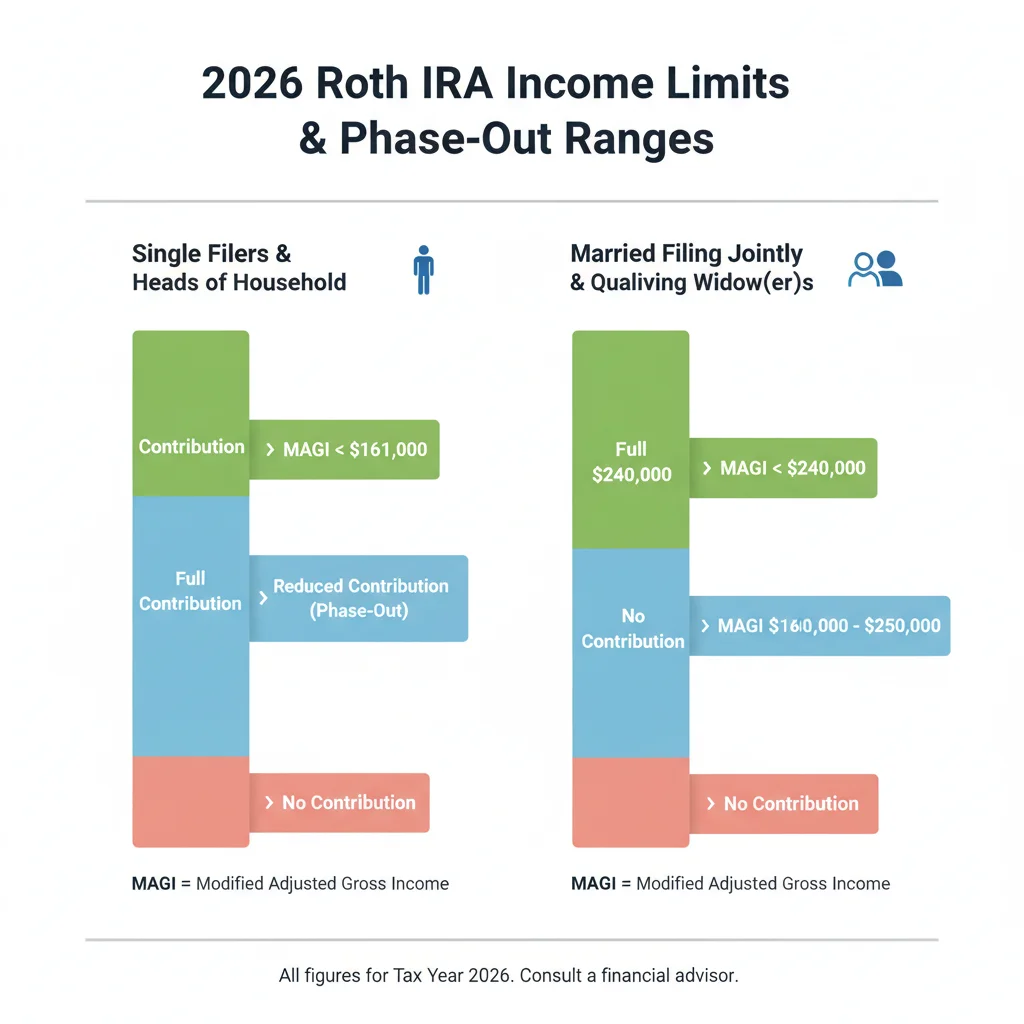
One of the primary challenges for high-income earners when considering a Roth IRA is the income limitation. The ability to contribute directly to a Roth IRA is phased out for taxpayers whose modified adjusted gross income (MAGI) exceeds certain thresholds. These thresholds are also adjusted annually for inflation. For 2026, we can anticipate these limits to increase slightly from 2025 projections.
Estimated 2026 MAGI Limits for Direct Roth IRA Contributions:
Single Filers, Heads of Household, or Married Filing Separately (and did not live with spouse at any time during the year):
Phase-out begins around $160,000 – $170,000
Completely phased out around $175,000 – $185,000
Married Filing Jointly or Qualifying Widow(er):
Phase-out begins around $240,000 – $250,000
Completely phased out around $255,000 – $265,000
Married Filing Separately (and lived with spouse at any time during the year):
Phase-out begins at $0
Completely phased out around $10,000
These figures are estimates, and the actual limits for Roth IRA 2026 eligibility will be released by the IRS. It’s crucial for individuals close to or above these income thresholds to monitor the official announcements carefully. If your income exceeds these limits, direct contributions to a Roth IRA may not be possible, but don’t despair—there are alternative strategies, such as the ‘backdoor Roth’ that we will discuss shortly.
Strategic Approaches to Maximizing Your Roth IRA 2026
Once you understand the basic rules and projected limits, the next step is to formulate a strategy to maximize your Roth IRA 2026 contributions. Here are several approaches to consider:
1. Automate Your Contributions
The simplest and most effective way to ensure you hit the maximum contribution limit is to automate your savings. Set up a recurring transfer from your checking or savings account to your Roth IRA. Dividing the annual maximum by 12 (for monthly contributions) or 26 (for bi-weekly contributions) can make the process seamless and less burdensome. For example, if the 2026 limit is $8,000, a monthly contribution of approximately $667 will get you there.
2. Prioritize Roth IRA Contributions Early in the Year
Contributing early in the calendar year allows your money more time to grow tax-free. The power of compounding is amplified when your investments have more time in the market. While contributing at any point is better than not contributing at all, front-loading your Roth IRA 2026 contributions can provide a significant advantage over the long run.
3. Leverage the ‘Backdoor Roth’ Strategy
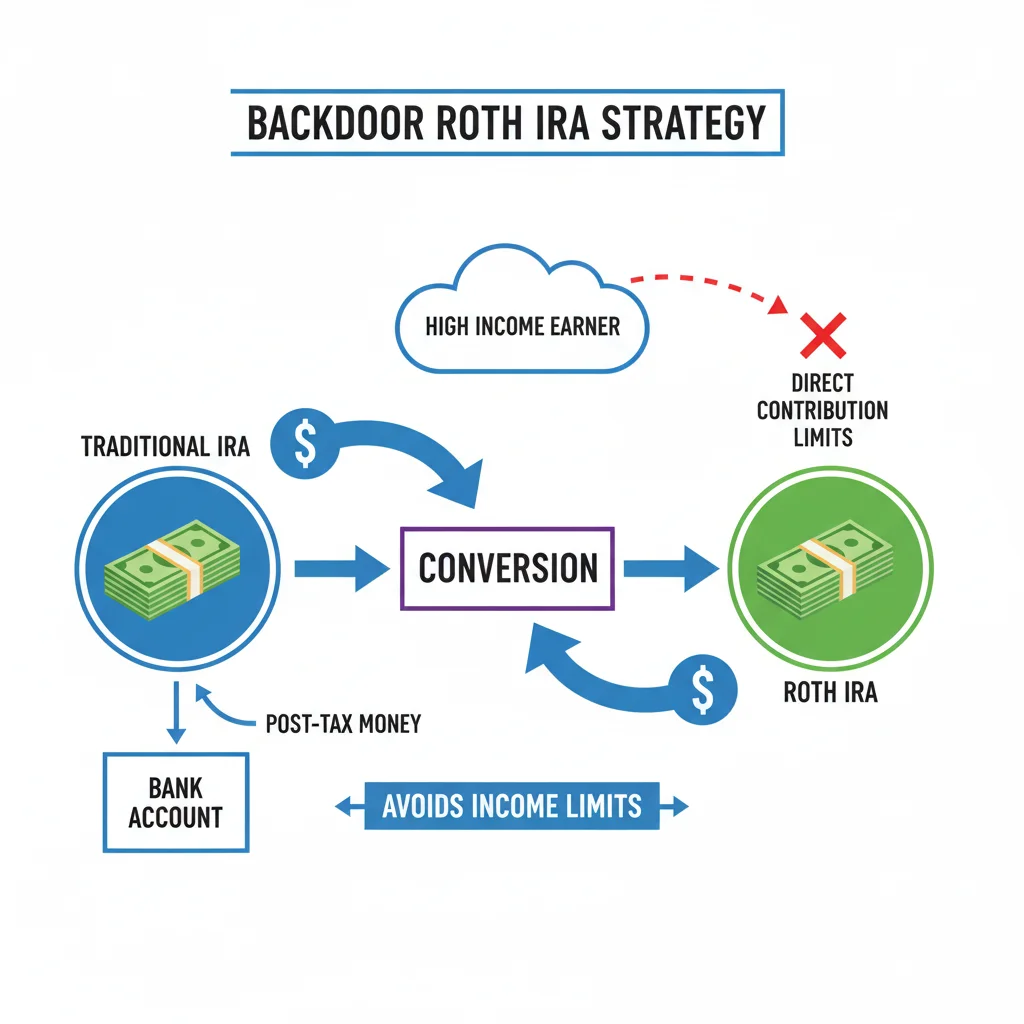
For high-income earners who exceed the direct contribution limits, the ‘backdoor Roth’ strategy is an invaluable tool. This involves contributing after-tax dollars to a traditional IRA and then immediately converting those funds to a Roth IRA. Since traditional IRA contributions made with after-tax dollars are not tax-deductible, the conversion itself is typically a non-taxable event (assuming no pre-tax IRA money exists). This strategy allows individuals to bypass the income limitations for direct Roth contributions.
To execute a backdoor Roth IRA 2026 effectively:
Ensure No Pre-Tax IRA Money: The ‘pro-rata’ rule dictates that if you have existing pre-tax funds in any traditional, SEP, or SIMPLE IRAs, a portion of your conversion will be taxable. To avoid this, it’s often advisable to roll over any pre-tax IRA funds into a 401(k) or similar employer-sponsored plan before performing a backdoor Roth.
Contribute After-Tax: Make sure your traditional IRA contribution is designated as non-deductible.
Convert Promptly: Convert the funds to a Roth IRA as soon as possible to minimize any potential earnings on the non-deductible contribution that would then be taxable upon conversion.
File Form 8606: You must file Form 8606, Non-deductible IRAs, with your tax return to report both the non-deductible contribution and the conversion.
The backdoor Roth strategy remains a legitimate and widely used method for maximizing your Roth IRA 2026, provided you navigate the rules carefully.
4. Consider a Roth 401(k) or Roth 403(b) if Available
If your employer offers a Roth 401(k) or Roth 403(b) option, this can be another excellent way to build tax-free retirement savings. These accounts typically have much higher contribution limits than a Roth IRA (e.g., $23,000 in 2024 for those under 50, plus a catch-up contribution). While contributions are still after-tax, they grow and can be withdrawn tax-free in retirement, similar to a Roth IRA. Utilizing both a Roth 401(k) and a Roth IRA 2026 can significantly boost your tax-free retirement nest egg.
5. Spousal Roth IRA Contributions
If you are married and file jointly, and one spouse earns little or no income, the working spouse can contribute to a ‘spousal IRA’ for the non-working spouse. This allows both spouses to contribute to a Roth IRA, effectively doubling the household’s annual Roth contributions, provided the couple’s combined earned income is at least equal to the total contributions made to both IRAs.
Investment Strategies within Your Roth IRA 2026
Once you’ve contributed to your Roth IRA 2026, the next critical step is to invest those funds wisely. The Roth IRA is merely a wrapper; the growth potential comes from the investments held within it. Since all qualified withdrawals are tax-free, Roth IRAs are ideal for investments with high growth potential or those that generate significant income (like dividends or interest) that would otherwise be taxed annually in a taxable brokerage account.
Ideal Investments for a Roth IRA:
Growth Stocks: Companies with high growth potential that you expect to appreciate significantly over time.
Dividend Stocks/ETFs: While dividends are typically taxed, in a Roth IRA, they are received tax-free and reinvested, further accelerating tax-free growth.
Exchange-Traded Funds (ETFs) and Mutual Funds: Diversified funds that align with your risk tolerance and investment goals. These can be actively managed or passively indexed.
Long-Term Investments: Any asset you plan to hold for many years to maximize the tax-free compounding effect.
It’s generally advisable to avoid putting investments that generate tax losses (like certain speculative options strategies) or tax-advantaged investments (like municipal bonds, which are already tax-free) into a Roth IRA, as you would be forfeiting their unique tax benefits.
Monitoring and Adjusting Your Roth IRA 2026 Strategy
Financial planning is not a one-time event; it’s an ongoing process. As you plan for your Roth IRA 2026, it’s essential to regularly review your strategy and make adjustments as needed. Life events, changes in income, and shifts in tax laws can all impact the optimal way to manage your Roth IRA.
Factors to Monitor:
IRS Contribution and Income Limits: Stay updated on the official limits for 2026 and subsequent years.
Your MAGI: As your income changes, reassess your eligibility for direct contributions or the need for a backdoor Roth.
Investment Performance: Regularly review the performance of the investments within your Roth IRA to ensure they are aligned with your long-term goals and risk tolerance. Rebalance your portfolio as necessary.
Tax Law Changes: Congress can change tax laws, including those affecting retirement accounts. Stay informed about potential legislative changes that could impact Roth IRAs.
Life Events: Marriage, divorce, having children, or changing jobs can all affect your financial situation and retirement planning needs.
For instance, if your income unexpectedly rises above the direct contribution limits for Roth IRA 2026, you’ll need to pivot to a backdoor Roth strategy. Conversely, if your income falls, you might be able to revert to direct contributions. Flexibility and informed decision-making are key to long-term success.
Common Misconceptions About Roth IRAs
Despite their popularity, several misconceptions about Roth IRAs can deter individuals from fully utilizing them. Addressing these can help clarify your Roth IRA 2026 planning.
Myth 1: You can only contribute to one type of IRA.
Reality: You can contribute to both a traditional IRA and a Roth IRA in the same year, as long as your total contributions across all IRAs do not exceed the annual limit. However, your ability to deduct traditional IRA contributions may be limited if you also participate in an employer-sponsored retirement plan.
Myth 2: My income is too high, so I can’t have a Roth IRA.
Reality: While direct contributions have income limits, the backdoor Roth strategy allows high-income earners to indirectly fund a Roth IRA. Furthermore, there are no income limits on converting traditional IRA funds to a Roth IRA, only on direct contributions.
Myth 3: Roth IRAs are only for young people.
Reality: While younger individuals benefit most from the long compounding period, Roth IRAs can be valuable at any age. Even those closer to retirement can benefit from tax-free growth and withdrawals, especially if they anticipate being in a higher tax bracket later or want to leave a tax-free legacy to heirs.
Myth 4: I can’t withdraw my money until retirement.
Reality: You can withdraw your contributions (the money you put in) from a Roth IRA at any time, tax-free and penalty-free. Earnings, however, are subject to the five-year rule and age 59½ requirement for qualified tax-free withdrawals. This flexibility makes the Roth IRA a unique blend of retirement savings and emergency fund potential.
The Role of a Financial Advisor in Your Roth IRA 2026 Planning
Navigating the complexities of retirement planning, especially with evolving tax laws and personal financial situations, can be challenging. A qualified financial advisor can be an invaluable resource in maximizing your Roth IRA 2026 contributions and overall retirement strategy.
How an Advisor Can Help:
Personalized Strategy: An advisor can assess your unique financial situation, income, and goals to create a personalized Roth IRA strategy.
Tax Optimization: They can help you understand the tax implications of various strategies, including the backdoor Roth, and ensure you’re complying with all IRS rules.
Investment Selection: Advisors can guide you in selecting appropriate investments within your Roth IRA that align with your risk tolerance and long-term objectives.
Staying Updated: They stay abreast of changes in tax laws and contribution limits, ensuring your plan remains optimized year after year.
Holistic Planning: A Roth IRA is just one piece of the puzzle. An advisor can help integrate your Roth IRA into a broader financial plan that includes other retirement accounts, investments, and estate planning considerations.
Even if you’re confident in managing your own investments, a periodic review with a financial professional can provide peace of mind and uncover opportunities you might have overlooked. This is particularly true when considering advanced strategies like the backdoor Roth, where precision is key.
Conclusion: Secure Your Future with a Maxed-Out Roth IRA 2026
The Roth IRA remains one of the most powerful and flexible retirement savings vehicles available, offering unparalleled tax-free growth and withdrawals in retirement. By proactively planning for your Roth IRA 2026 contributions, understanding the projected limits, and employing smart strategies like automation and the backdoor Roth, you can significantly enhance your financial security.
Remember to stay informed about official IRS announcements regarding contribution limits and income thresholds. Prioritize maxing out your contributions early in the year, and carefully consider the types of investments you hold within your Roth account to maximize its tax-free potential. Whether you’re just starting your career or nearing retirement, leveraging the Roth IRA effectively can lead to a more prosperous and tax-efficient future. Start planning today to make the most of your Roth IRA in 2026 and beyond.
Matheus Neiva has a degree in Communication and a specialization in Digital Marketing. Working as a writer, he dedicates himself to researching and creating informative content, always seeking to convey information clearly and accurately to the public.